
Honolulu County Release Records
In Honolulu County, “released” describes the end of one custody episode, not always the end of all custody. The Hawaiʻi Department of Corrections and Rehabilitation, or DCR, runs Oʻahu Community Correctional Center and the state prisons on Oʻahu. A person may leave OCCC for the community after bail, release on recognizance, dismissal, probation, or time served. Someone else may leave OCCC only because DCR moved the person to Hālawa, Waiawa, WCCC, a federal authority, or an immigration authority. The first event is a community release. The second is a transfer.
A sound Honolulu County released inmate check answers who held the person, why that custody ended, when the change took effect, and who received the person next. DCR’s executed movement or release entry is the best operational proof. The Oʻahu criminal docket can show the legal authority, while Hawaiʻi SAVIN can give a prompt public status clue. Parole is supervised release from a prison sentence. Probation is court supervision that may follow a jail stay or may replace prison. Discharge means the relevant custody or supervision term has ended.
Honolulu County Release Types
DCR uses more exact terms than a simple “released” label. Its records can distinguish bail, bond, release on recognizance, supervised release, probation, parole, time served, dismissal, discharge, and return to another authority. The distinction matters because a closed facility episode can still lead to another custodian. Ask DCR for the meaning of any abbreviated disposition code instead of guessing.
| Release type | What it means | Next record |
|---|---|---|
| Bail, bond, or ROR | A court-authorized community release while the case continues | eCourt Kōkua bail order and DCR release entry |
| Time served or dismissal | Custody on that case may end, subject to other holds | Court disposition plus executed movement record |
| Probation | Court supervision in the community | Judiciary Adult Client Services and the judgment |
| Parole | Community release under HPA supervision | HPA action, DCR record, and SAVIN status |
| Transfer or detainer pickup | Custody changes hands but does not end | The receiving DCR, federal, or immigration authority |
Three dates may appear. A tentative date predicts a possible release. A legal effective date comes from a court, sentence calculation, or HPA action. The physical release time records when custody actually changed. A hold, identity check, transport issue, or later order can separate those dates.
Fields in Honolulu Release Records
A focused record request is more useful than a demand for an entire inmate file. DCR may redact protected identifiers, victim data, medical facts, security details, or confidential supervision material, but it can assess whether basic custody fields are segregable. “Segregable” means that public portions can be separated from exempt material.
| Field | What it establishes |
|---|---|
| Name and DCR identifier | Which person the custody episode concerns |
| Admitting and releasing facility | The physical and legal custodian |
| Admission and actual release date | The span of that custody episode |
| Disposition and code definition | Why the episode closed |
| Destination or receiving authority | Community release versus continued custody |
| Release checklist or movement entry | Whether staff executed the authorized change |
| Tentative date | A prior calculation, not proof of release |
HRS §353-12 requires DCR to maintain records of admission, sentence, parole, discharge, and other major status events. That duty proves the records exist, but it does not make every page public. The best request seeks the minimum fields needed to confirm a release and asks for the definition of the recorded code.
Request Honolulu County Release Records
Hawaiʻi’s Uniform Information Practices Act, HRS chapter 92F, provides the formal path. Use the Office of Information Practices request form and send it to the agency that maintains the record. Honolulu does not have a county sheriff jail records unit. A DCR release request goes to DCR, an HPD cellblock release goes to HPD, and a court order goes to the Judiciary clerk.
- Identify the custodian and approximate custody dates.
- Give the full name plus a lawful differentiator such as case number or DCR number.
- Ask for admission, actual release date and time, facility, disposition code and definition, destination, and releasable executed record.
- Request a segregable electronic copy and an advance fee estimate.
- If part is denied, ask DCR to cite the exemption and release the nonexempt fields.
1177 Alakea Street
Honolulu, HI 96813
808-587-1288
Fax: 808-587-1282
DCR’s public-access policy describes search, review, separation, and copying charges, so no single flat fee fits every request. The State Archives publishes DCR retention schedules, but the research does not support one universal retention period for each release file. OCCC’s Records Unit maintains active and inactive inmate files, which supports asking for older episodes. A sealed or expunged matter may restrict some arrest or court information without erasing every operational record at once.
Honolulu Release Record Laws
HRS chapter 92F establishes access to Hawaiʻi government records while preserving privacy and other lawful exceptions. HRS §92F-11 supplies the access rule, and §92F-13 addresses exemptions. Basic release dates, facilities, and dispositions may be easier to separate than protected addresses, medical data, victim details, security material, juvenile records, or confidential supervision information. An agency should state its legal ground when it withholds material.
A public release record is not the same as a certified court record. Obtain certified judgments from the court and operational release proof from the custodian.
Hawaiʻi expungement under HRS §831-3.2 is fact-specific and generally concerns qualifying arrest information. Court sealing follows a separate process. Neither remedy should be described as automatic removal of every DCR entry, court document, or archived copy. A correction request should go to the agency that maintains the disputed record.
Find Released Honolulu County Inmates
Begin with the custodian, not a generic roster. OCCC and the Oʻahu prisons belong to DCR. HPD cellblocks are short-term police holding sites. FDC Honolulu is federal, and ICE custody has its own locator. Once the correct system is known, use this sequence.
- Search the named person in Hawaiʻi SAVIN and note the exact agency, place, status, and update time.
- Search eCourt Kōkua for the Oʻahu case and read recent bail, dismissal, probation, sentencing, or commitment entries.
- For a prison case, ask HPA whether parole became effective. A hearing or minimum term alone is not release.
- For a federal case, use BOP and the federal docket. Check ICE when a detainer or immigration transfer appears.
- Request DCR’s executed release or movement record when exact time, disposition, or destination matters.
A released person commonly drops from a current custody view. No result may also reflect spelling, age, a transfer, or an older record, so absence alone proves nothing.
For an old case, the court is often the best first step because the docket lasts longer than a live custody result. Use date of birth, middle name, case number, arrest date, or agency identifier to separate people with similar names. Record the source, the time checked, and the status words. Do not publish private identifiers simply to document the search.
Hawaiʻi SAVIN Release Search
The official public DCR path is Hawaiʻi SAVIN, powered by VINE/VINELink. It covers custody and parole status for people under DCR jurisdiction. It is a person-specific notification service, not a complete historical offender database and not a list of everyone released today.
| Search or result field | Use | Limit |
|---|---|---|
| Name and identity filters | Find and distinguish a person | Interface options can change |
| Agency or location | Shows the reported custodian | A transfer may change it |
| Custody or parole status | Gives a current public clue | Not a certified release document |
| Status update | Dates the displayed information | Not always the physical exit time |
| Notification controls | Registers phone, text, email, or app alerts | Alerts still require verification |
The Hawaiʻi VINELink search screen shows the statewide person-search route.
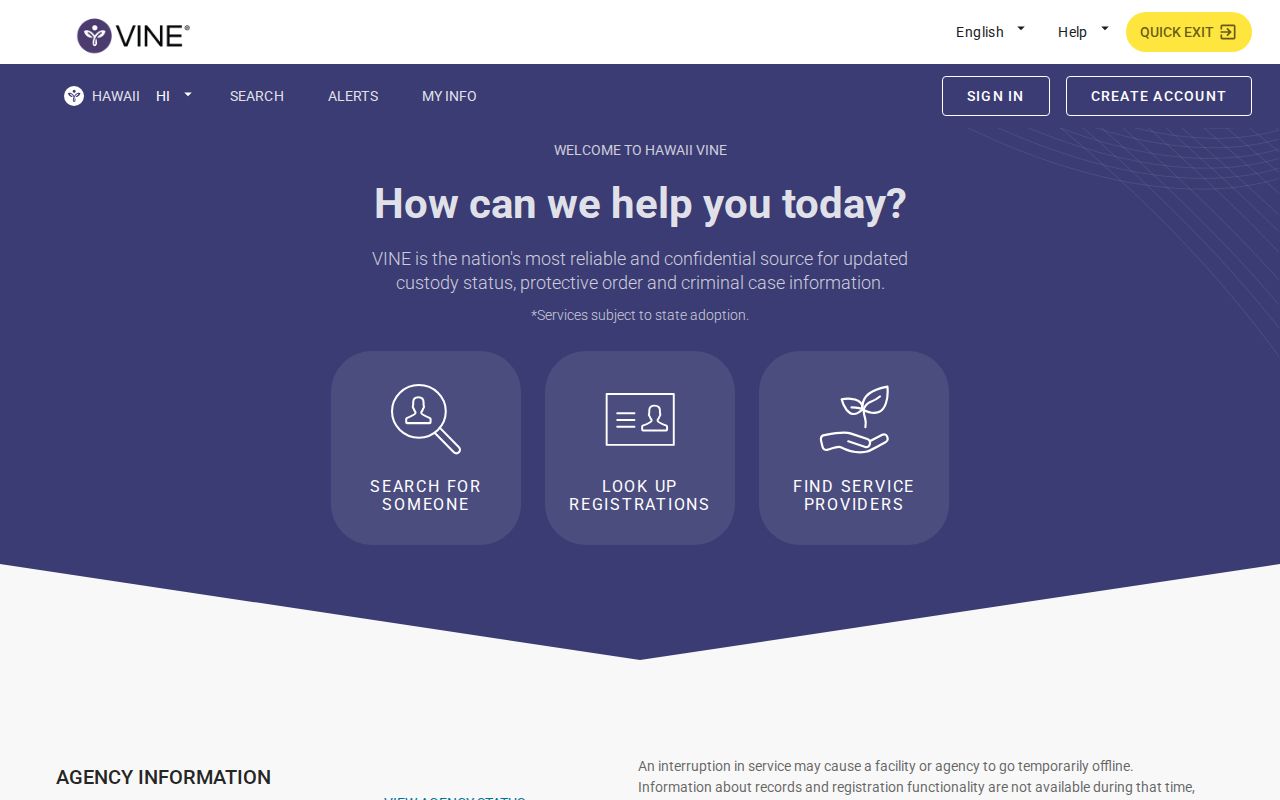
The image points to the correct state system, but an executed DCR movement record remains the firmer source for a release time and destination.
Honolulu County Recent Release Paths
No official Honolulu County or DCR rolling 24-hour or 72-hour released-person feed was found. Honolulu has no county sheriff jail site because DCR operates OCCC. Hawaiʻi SAVIN can check one named person, while HPD arrest logs provide a useful recent trace for police arrests. Neither is a browsable county release list.
HPD’s current arrest logs use fields and disposition codes that can show whether a police episode ended by bail, release, or transfer. The logs rotate after fourteen days under HPD policy. That window belongs to the public log, not the underlying arrest record. When the entry has rotated out, submit a written request to HPD Records and Identification and specify the dates. If the person entered OCCC, switch to DCR and the court record.
Honolulu Post-Release Supervision
The Hawaiʻi Paroling Authority decides parole for eligible state prisoners and supervises people released on parole. The Judiciary’s Adult Client Services Branch handles probation. A DCR prison release to parole therefore follows DCR and HPA records, while an OCCC release to probation follows the judgment and court supervision chain. Hawaiʻi SAVIN also carries parole-status notifications for DCR offenders.
There is no verified public statewide probationer name search or complete Honolulu absconder list. Check the judgment and later docket entries for probation, modification, revocation, or discharge, then contact the proper First Circuit office for a lawful status question. The Honolulu County parole and probation page separates those routes in detail.
Honolulu Federal Release Checks
VINE registration may provide phone, text, email, or in-app notice for DCR custody and parole changes. It does not replace the federal systems. For a person who served a federal sentence, the BOP Inmate Locator can display a release date or a released status. A former BOP result does not rule out later DCR, ICE, or USMS custody.
ICE’s Online Detainee Locator searches current detainees and, under ICE’s published scope, some people released within the last sixty days. It uses an A-number and country of birth or exact biographical details. “Not found” can reflect recent processing, spelling, an excluded category, age, transfer, or the time window. A DCR handoff to ICE or USMS is a change of custodian, not release to the community.
Honolulu Custody Status Sources
Match the question to the source. A live status service can point to present custody, but a durable file is needed for an older release. Court records explain legal authority and do not always capture the door time.
| Source | Best use | What it cannot prove alone |
|---|---|---|
| HI SAVIN | Current DCR custody or parole clue and alerts | Certified release time or full history |
| DCR inmate file | Executed release, movement, disposition, destination | Every field is publicly releasable |
| eCourt Kōkua | Bail, dismissal, sentence, probation, commitment | Physical exit at an exact time |
| HPA | Parole action and supervision | Probation status |
| BOP locator | Federal sentence custody and released result | State, ICE, or later custody |
| ICE ODLS | Covered current and recent immigration custody | A complete historical release archive |
Honolulu County Release Facilities
Facility type controls the search. OCCC is the main Oʻahu jail, and Laumaka is a pre-release or furlough setting where community activity may occur before legal discharge. Hālawa and Waiawa are men’s prisons. WCCC is both Hawaiʻi’s women’s prison and an Oʻahu pretrial jail for women. FDC Honolulu, HPD cellblocks, and immigration custody require separate federal or police paths.
- Oʻahu Community Correctional Center: use DCR, SAVIN, and the Oʻahu court record.
- Laumaka Work Furlough Center: confirm whether DCR custody, parole, or sentence completion applies.
- Hālawa Correctional Facility: verify prison discharge or parole through DCR and HPA.
- Waiawa Correctional Facility: distinguish reentry programming from executed release.
- Women’s Community Correctional Center: check both pretrial and sentenced status.
- Federal Detention Center Honolulu: use BOP and the federal docket.
- Honolulu Police Department Cellblocks and Federal and Immigration Custody: use HPD, ICE, USMS, and court channels as applicable.
How Honolulu Releases Are Processed
DCR policy gives an unusually clear view of physical release. Staff verify identity through records and identifying information, collect state-issued property, return personal items and money as soon as practical, complete required notices, and update Offendertrak at once. If that system fails, staff must make the call needed for a SAVIN notice. For supervised release, staff also verify the sponsor or program. These steps explain why an authorized release and the actual departure may not share the same moment.
A detainer changes the result. Staff contact the agency that placed the hold and do not release the person to the community unless the hold is rescinded or the other agency takes custody. Ask for the destination and receiving authority whenever the DCR disposition suggests a return, transfer, or hold.
Honolulu Release Disposition Data
DCR’s FY2024 annual report publishes local release-disposition counts and median lengths of stay using terms such as bail, bond, ROR, parole, probation, dismissal, time served, and return to another authority. Those tables are better context than a generic national figure because they reflect Hawaiʻi’s unified system. Use only the geography, population, and reporting period named in the table. A statewide count should never be recast as a Honolulu County rate.
The code set also shows why “released” needs interpretation. A return-to-other-authority entry may close the DCR episode while confinement continues elsewhere. The data dictionary and individual movement record should control the meaning.
Honolulu Furlough Is Not Discharge
OCCC manages Laumaka Work Furlough and DCR describes Project Bridge and other reintegration work. These programs can place a participant in the community for approved activity while DCR retains legal custody. Program participation is therefore a clue about the release path, not proof that the sentence or custody has ended.
Ask DCR for the legal status on the date in question. If parole later became effective, confirm it through HPA and the executed DCR event. If the person merely moved from OCCC to Laumaka, treat the change as an internal custody transition.
Property After Honolulu Release
DCR’s release procedure directs staff to return personal items and money as soon as practical. If property is missing or an entry appears wrong, contact the releasing facility and DCR records office with the name, custody episode, and date. Ask for the supporting acknowledgment or movement record and use DCR’s correction process for an agency record that is inaccurate.
Keep a copy of the request and the agency response. Property questions belong with the releasing facility, while a disputed court order belongs with the clerk or the court process.
Honolulu Court Release Trail
Oʻahu research crosses District and Circuit Court. Older migrated cases may need a circuit and case-type prefix plus leading zeroes to form the modern twelve-character case number. The Judiciary’s eCourt guidance explains that format. Search the party and then read bail, bond, minutes, judgments, dispositions, probation orders, mittimus entries, and later activity.
A docket can outlast a custody search, but it describes legal events. “Bail posted” may authorize release without recording the actual exit. “Time served” may end one case while another hold remains. A commitment or mittimus generally points to continued DCR custody.
Honolulu Detainers and Transfers
A DCR release to ICE, USMS, another state, or another DCR facility is not freedom from custody. DCR policy requires staff to resolve the detainer or transfer the person to the placing authority. The release record should therefore include destination or receiving authority whenever possible.
Continue the search with that agency. BOP covers designated federal prisoners, ICE ODLS covers its stated immigration population and time window, and the federal docket explains court-ordered release or remand. USMS has no general public detainee locator.
WCCC Changes Honolulu Searches
WCCC’s 2024 expansion made Hawaiʻi’s only women’s prison a hybrid prison and jail for Oʻahu women. A search limited to OCCC can miss a woman held pretrial or serving a sentence at WCCC. Confirm the facility and legal status through DCR and SAVIN, then use the court for a local case or HPA for a prison parole.
A move between WCCC units is not release. Ask for the actual movement disposition and whether the person left DCR custody, entered parole, or remained confined.
Honolulu Release Alert Registration
Hawaiʻi SAVIN allows an anonymous person search without an account. After selecting the right individual, a user can register available phone, text, email, and in-app channels. DCR recommends more than one method. Telephone alerts use a four-digit PIN to confirm receipt. When a call is missed, VINE may leave a message and continue calling for at least twenty-four hours or until the PIN is entered.
Registration is also available through 1-877-846-3444, the VINELink mobile app, and TTY at 1-866-847-1298. Hawaiʻi SAVIN’s office number is 808-587-1356. The service describes release, discharge, and escape notifications, but its notice is not a certified record and should not be the sole basis for a safety decision. Confirm the release disposition with DCR, the court, or HPA.
Honolulu Tentative Release Dates
DCR’s local term is “tentative date of release.” OCCC’s Inmate Records Unit computes pre-confinement calculations and the tentative date, processes the legal documents that support release, and maintains active and inactive files. The field exists in the institutional record, but DCR’s public SAVIN description does not promise that it appears on a public person profile.
Request the calculation sheet, controlling court papers, jail credit, maximum term, HPA minimum-term order when relevant, and the current tentative date. A later credit decision, consecutive or concurrent sentence issue, authorized disciplinary change, new hold, parole action, or court order may alter it. Bail, ROR, and dismissal releases are not earned-time projections. Hawaiʻi research found no universal rule requiring every adult prisoner to serve eighty-five percent of a term.
Honolulu Parole Date Meaning
HPA uses “tentative parole date” for the expiration of the longest controlling minimum sentence. Reaching that date makes the person eligible for the parole process; it does not guarantee departure that day. HRS §706-669 governs minimum-term proceedings for covered indeterminate sentences. HRS §706-670 addresses parole hearings before the controlling minimum expires and later hearings when parole is denied.
For a named person, obtain the HPA action and then match it with DCR’s executed release event. A minimum-term order, scheduled hearing, or favorable recommendation is not physical release. HPA publishes aggregate outcomes but no verified comprehensive name-level decision search. Call HPA through its official contact page for releasable action information.
Honolulu Police Release Trace
A person released from an HPD cellblock before OCCC intake may never appear as a DCR inmate. HPD arrest logs are therefore a useful first trace. They include arrest identifiers, location and time, offense information, and disposition codes. Read the code legend. A disposition such as bail or release differs from transport to OCCC, which starts a new DCR custody episode.
Central Receiving operates the main Alapaʻi cellblock at 801 South Beretania Street. Its custody-information line is 808-723-3000, and Central Receiving is 808-723-3284. HPD describes the Adult Release door at the rear of the station for a person arranging bail. The agency estimates that the bailout process may take about thirty minutes, but that estimate is not a promise of release time. Another warrant, identification step, or hold can change the result.
Honolulu Release Terms Defined
Precise terms prevent false conclusions. A detainer is a request from another authority to hold or transfer a person. A mittimus is a court commitment directing custody. Release on recognizance, often called ROR, permits release without cash bail under court terms. Time served means the court credits the confinement already completed on that matter.
- Parole
- Community supervision during the remaining prison sentence under HPA.
- Probation
- Court-ordered community supervision handled by the Judiciary.
- Discharge
- The end of the specified custody or supervision authority.
- Expungement
- A legal process for qualifying arrest information, not a universal deletion of every related record.
- Transfer
- A move to another facility or authority while custody continues.
Always interpret the term in the individual court, DCR, HPA, or federal record. Similar words can describe different legal events in separate systems.
Public Record Search
Sponsored Results