
Hālawa Prison Release Paths
Hālawa Correctional Facility is a DCR male prison on Oʻahu. Its release population consists of sentenced state prisoners, so the central questions are whether a sentence expired, HPA authorized parole, or DCR transferred the person. A final discharge can end the prison term. Parole ends confinement but begins legal supervision. Neither should be confused with a movement to Waiawa, OCCC, Laumaka, WCCC, Saguaro, or another institution.
The destination field is decisive. A DCR movement date only establishes that Hālawa custody changed. If the receiving location is another correctional site, the person remains confined. If the disposition is parole, obtain the HPA action and effective date. If it is discharge, ask DCR for the sentence-completion or release entry. The Honolulu released-inmate search guide supplies the broader source sequence when the last facility is unknown.
Confirm a Hālawa Release
Use the official Hawaiʻi SAVIN page to reach the state’s VINELink person search. Compare the result with known identity details and preserve the exact status, agency, facility, and update date. SAVIN covers DCR custody and parole status, but it is not a certified historical discharge record. A missing result can reflect a transfer, spelling, old data, or system timing.
- Search HI SAVIN. Identify the correct person and note the exact live wording.
- Check HPA. For a claimed parole, request the releasable board action and effective date.
- Read the sentencing case. Review judgment, sentence, credit, and later orders in eCourt Kōkua.
- Request the DCR event. Ask for the executed release or movement date, disposition, and destination.
A tentative parole date is the expiration of the longest controlling minimum for parole consideration, not a guaranteed exit. The actual HPA decision and DCR execution must support the claimed release.
Hālawa Records and Contact
DCR lists Hālawa at 99-902 Moanalua Road, Aiea, HI 96701. The published visitation hotline is 808-485-3550 and the fax is 808-483-7275. Those contacts concern facility operations and visitation. A historical discharge request should be routed to the DCR office that maintains inmate records rather than framed as a visitation question.
Hālawa Correctional Facility
Address: 99-902 Moanalua Road, Aiea, HI 96701
Visitation hotline: 808-485-3550
Fax: 808-483-7275
Operator: Hawaiʻi DCR
DCR’s published UIPA routing contact is 1177 Alakea Street, Honolulu, HI 96813, telephone 808-587-1288 and fax 808-587-1282. Give the full name, identifier where available, Hālawa date range, and exact fields sought. Ask for release date and time, disposition, destination, parole or discharge status, and releasable hold information. Request electronic delivery and an advance estimate. Hawaiʻi law permits redaction of protected personal, security, medical, victim, and supervision information.
Hālawa Admission and Discharge Records
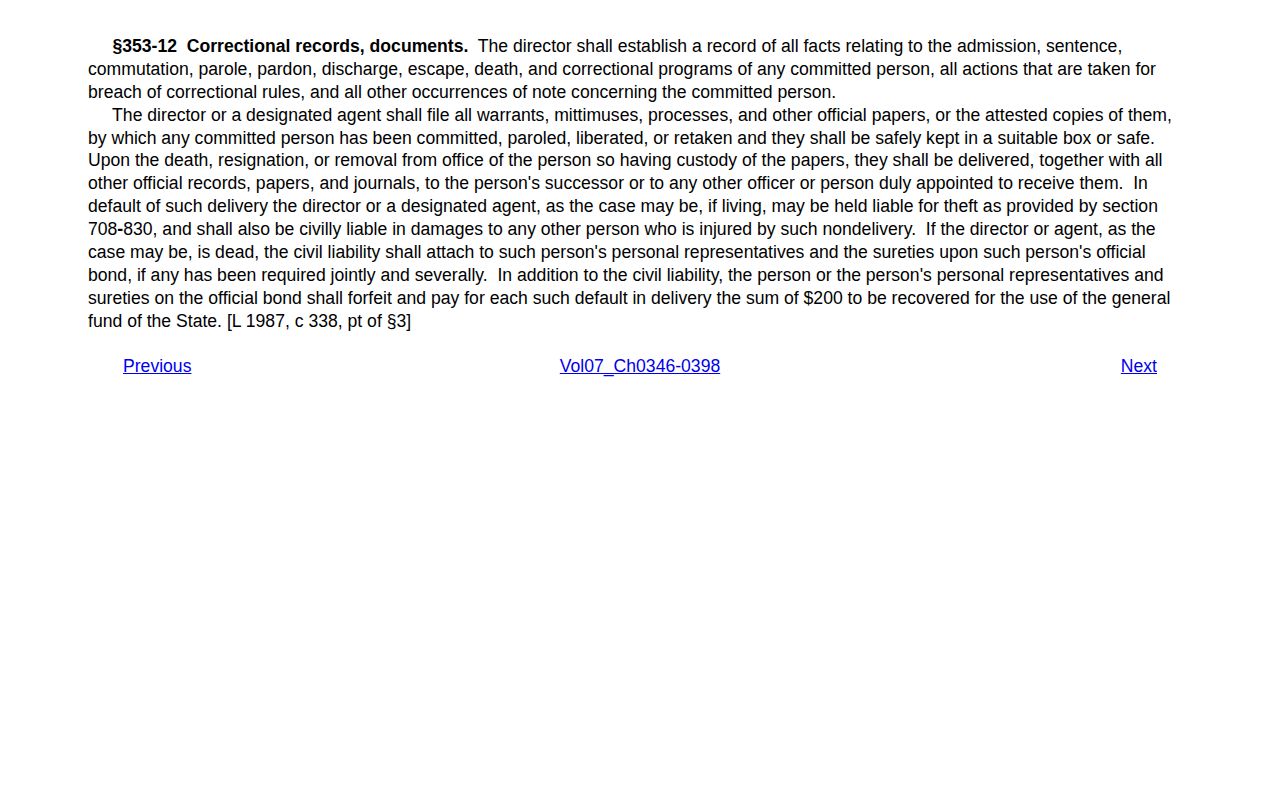
HRS §353-12 requires DCR to establish records of admission, sentence, commutation, parole, pardon, discharge, escape, death, and correctional programming. It also addresses preservation of official papers through which a person was committed, paroled, liberated, or retaken. That authority supports a narrow request for confirmation fields. It does not make every page in a prison release packet public.
| Field | What it resolves |
|---|---|
| Effective movement date | When Hālawa custody changed |
| Disposition code | Parole, discharge, transfer, or another result |
| Destination | Community supervision, another prison, or another agency |
| HPA action date | Whether parole was granted and when it took effect |
| Hold status | Whether a detainer redirected the person |
Ask DCR to define abbreviations such as PAR, DISC, or RTO rather than supplying a guess. DCR’s policy index marks release documentation confidential, so requesting minimum segregable fields is more precise than demanding the complete inmate file.
Hālawa Parole and Sentence Expiration
HPA fixes minimum terms for covered indeterminate sentences and later decides parole. HRS §706-669 governs the minimum-term process, while HRS §706-670 addresses parole hearings and maximum expiration. A minimum term is not the full sentence and does not promise release on its last day. Mandatory minimums, institutional conduct, a pending Hawaiʻi felony, specified offense categories, and the absence of an approved parole plan can affect the decision under the cited framework.
If HPA denies parole, later hearings can occur within the statutory process. If parole is granted, conditions and an effective process follow. If no earlier release occurs, maximum expiration controls. Research found no enacted universal adult 85-percent rule and no general earned-time shortcut allowing a blanket calculation. Tie every estimate to the judgment, HPA minimum-term order, current board action, and DCR sentence record.
Hālawa Detainers and Other Custodians
DCR COR.16.02 makes detainer handling part of the release process. Staff contact the agency that placed a hold and do not release the person to the community unless the detainer is rescinded or that authority takes custody. A Hālawa record can therefore show the end of DCR imprisonment while ICE, USMS, or another jurisdiction begins custody.
Always request the receiving authority. If ICE took custody, use the ICE Online Detainee Locator and remember its limited recent-release window. If USMS took custody, the federal docket is often more useful because no general public USMS detainee locator exists. If BOP is involved, its locator can show federal location or a past release date, but “Released” from BOP does not rule out state or immigration custody. The chain is complete only when each transfer is reconciled.
Hālawa Record Access in Practice
The successful project image comes from the official text of HRS §353-12. It documents DCR’s duty to keep admission, parole, and discharge records. The image supports the legal record path without implying that a public statewide Offendertrak archive exists.
DCR ADM.05.02 describes public access at department offices and a request process, but the current agency estimate should control fees and timing. Its three-year retention statement concerns the request form, not the underlying inmate file. State Archives publishes a DCR retention schedule, yet the research did not support assigning one clear retention period to every Hālawa release record. Ask whether the specified record remains maintained.
WCCC’s Distinct Oʻahu Role
WCCC’s 2024 expansion made Hawaiʻi’s only women’s prison a hybrid prison and jail for Oʻahu women. Those facts do not describe Hālawa, which is a male state prison. They matter as a search safeguard: a Honolulu query that assumes every state prisoner was at Hālawa can miss women held at WCCC and people at Waiawa or an off-island placement.
Match sex, court case, DCR identifier, facility, and dates before requesting a record. If Hālawa has no episode, follow the actual institutional history rather than forcing the search into the most familiar prison name. Interfacility history can also explain why SAVIN shows a different location from an older court or news reference. Only the executed final event supports release.
Property and Status Corrections at Hālawa
COR.16.02 directs release staff to verify identity, collect state property, return personal items and money as soon as practical, address applicable registration and notification steps, and update Offendertrak immediately. If Offendertrak fails, staff use a contingency for SAVIN notification. These operational steps can create acknowledgments or status records useful when the public result appears wrong.
For missing property or an incorrect release entry, identify the Hālawa custody episode and describe the disputed field or item. Contact the facility and DCR records office. Ask for correction under the applicable DCR process or the releasable record that supports the entry. A phone answer may help route the issue, but a written request creates a clearer record of what was sought and how DCR responded.
Hālawa Court Records After Release
eCourt Kōkua can preserve the criminal case after a person no longer appears at Hālawa. Search by party name, compare aliases and case identifiers, and review bail, offenses, events, dockets, judgment, disposition, and sentence information. An ACTIVE, INACTIVE, or CLOSED case label describes the case, not bodily custody. A missing online document can also mean that the clerk holds a counter copy.
Use the docket to explain the legal basis for imprisonment or a later order, then use DCR to confirm execution. Older District criminal cases may not be online, and sealed, juvenile, or confidential material is excluded. When the court and SAVIN appear to conflict, preserve both update dates and ask DCR for the effective movement record rather than selecting the more convenient result.
Public Record Search
Sponsored Results