
Honolulu Tentative Versus Actual Release
OCCC’s Inmate Records Unit computes pre-confinement credit and a tentative date of release from legal documents. A tentative date predicts. The executed movement or release record confirms what occurred.
Pretrial custody turns on bail, court orders, dismissal, plea, or later sentence and usually has no sentence-completion date. A definite jail sentence and an indeterminate prison sentence follow different rules. Another agency’s hold can also prevent community release on the calculated day.
Find Honolulu Tentative Release Dates
No public DCR portal was verified to display the internal tentative date for every person. Build the answer from the sentence file.
- Read the judgment and sentence in eCourt Kōkua.
- Identify whether the person is pretrial, serving a definite jail term, or serving an indeterminate prison sentence.
- Ask DCR for the current calculation sheet, jail credit, controlling orders, maximum term, and tentative date.
- For an indeterminate term, obtain the HPA minimum-term order and later parole action.
- Check detainers, amended orders, and the receiving authority before treating the date as community release.
The full person-search sequence appears on the Honolulu released-inmate page.
Honolulu Sentence Date Computation
Research found no Hawaiʻi law requiring every adult prisoner to serve a universal 85 percent of the sentence, and no general earned-time shortcut to parole eligibility. Failed legislative proposals are not law. Each calculation must follow the judgment, current statute, custody credit, and any offense-specific mandatory term.
For an indeterminate sentence, HRS §706-669 governs the HPA minimum-term process. HRS §706-670 addresses parole hearings and maximum expiration. Presentence credit is governed by HRS §706-671 where applicable. Bail, dismissal, and release on recognizance are not earned-time calculations.
Why Honolulu Release Dates Change
A current calculation can change when the controlling legal facts change.
| Factor | Possible effect |
|---|---|
| Amended custody credit | Moves the sentence calculation |
| Consecutive or concurrent clarification | Changes how terms combine |
| New court order | Changes release authority |
| HPA decision | Grants, denies, or delays parole |
| Detainer | Causes transfer instead of community release |
| Disciplinary forfeiture or restoration where authorized | May alter the institutional calculation |
A tentative parole date is the expiration of the longest controlling minimum for parole consideration. It is not a promise of release that day.
Confirm Honolulu Release Dates
Register through the Honolulu VINELink check for a custody-status alert. Then compare the alert with the DCR release entry, court order, and HPA action. If another authority takes custody, check that agency too.
DCR’s policy index identifies release and sentence-related procedures. The current statute page is also a useful source image.
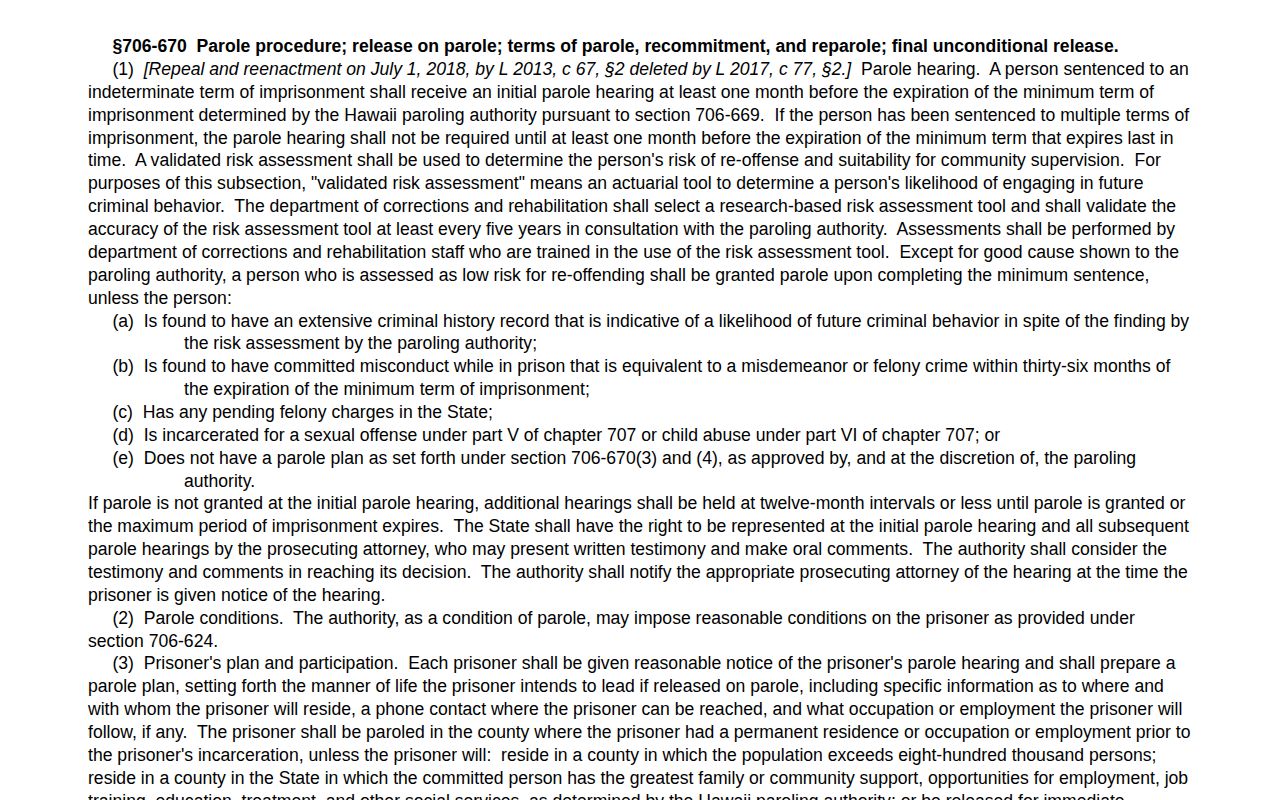
The statute explains the legal framework, while the individual file supplies the person-specific date.
Honolulu Tentative Date Record
The distinctive local field is the “tentative date of release” computed by the OCCC Inmate Records Unit. It is kept in the institutional record and supported by pre-confinement calculations and legal documents. Official public SAVIN material does not promise that the field appears online.
A focused UIPA request should ask for the current tentative date, calculation sheet, controlling orders, credited custody, and any hold affecting release. Request the actual movement entry later if the goal is to prove that release occurred.
Honolulu Sentence Types Matter
A projected date depends on the kind of custody. A pretrial detainee remains held while the case proceeds and may leave after bail, recognizance, dismissal, or another court order. Those events are not sentence projections. A person serving a definite jail term may have a completion date based on the court order and credited confinement.
State-prison terms can be indeterminate. That means the judgment sets a maximum while HPA establishes the controlling minimum for parole eligibility under Hawaiʻi law. Serving the minimum does not itself grant release. HPA considers parole, and the person must still have an approved plan and no other barrier to release.
Intermittent sentences, amended judgments, and concurrent or consecutive terms require the exact written order. Avoid computing a date from the sentence length alone. DCR records staff apply the legal documents and credits within the institutional file.
Honolulu Tentative Parole Dates
HPA’s Parole Handbook uses “tentative parole date,” or TPD, for expiration of the longest minimum sentence. The TPD marks a point of parole consideration. It does not guarantee that the person will leave custody on that date.
HRS §706-669 requires a minimum-term hearing within the statutory process for covered indeterminate sentences. HRS §706-670 provides for an initial parole hearing before expiration of the controlling minimum and later hearings when parole is denied, subject to the statute’s terms.
Mandatory minimums, life without parole, qualifying recent misconduct, a pending Hawaiʻi felony, specified offense categories, or the absence of an approved parole plan can affect the result. A denial requires written reasons. Read the judgment, minimum-term order, and latest HPA action together.
Honolulu Custody Credit Records
Presentence detention credit can affect both minimum and maximum terms when HRS §706-671 applies. The dates must be taken from the official custody history and judgment. Overlapping cases, transfers, and amended credit orders make informal arithmetic unreliable.
Ask for the pre-confinement calculation used by OCCC’s Inmate Records Unit. Compare it with the court’s mittimus or commitment order and any amended judgment. A mittimus is the written authority directing confinement or transfer. If the records disagree, request a correction from the office responsible for the disputed entry.
DCR’s public-access policy describes a correction process for an individual’s own record, with written routing to the responsible administrator or DCR Director. Those policy timelines should not be advertised as a guaranteed production date for every third-party UIPA request.
Honolulu Holds Change Release Outcomes
DCR release policy makes detainer review a required part of release. Staff contact the agency that placed the hold. The person is not released to the community unless the detainer is rescinded or the requesting agency takes custody.
This distinction matters for ICE, USMS, other state matters, and parole warrants. A DCR record may show that OCCC released the person while the destination confirms a transfer. Search the receiving agency and preserve both entries in the timeline.
Federal custody uses different sources. The BOP locator can show a release date for a sentenced federal prisoner, but that date does not prove absence from DCR or immigration custody. ICE ODLS has a limited recent-release window and other coverage restrictions. Neither date should be merged into a DCR tentative calculation.
Request Honolulu Date Calculations
A precise request identifies the person, DCR number if known, facility, case number, and custody period. Ask for the current tentative release date, the calculation sheet, credited detention, maximum term, controlling court order, HPA minimum-term order where applicable, and any releasable hold that affects the date.
DCR’s UIPA contact is routed through the Office of the Director at 1177 Alakea Street, Honolulu, phone 808-587-1288. Use the OIP government-record request form. Ask for a segregable electronic copy and an advance estimate if fees may apply.
After the projected day passes, request the executed movement or release record. That final record should identify the effective time, disposition, and destination. It is the proper evidence for actual release, while the earlier calculation remains evidence of what DCR expected.
Review Honolulu Date Sources
Place each source in order of authority. The judgment sets the sentence. HPA establishes the minimum and makes parole decisions for covered prison terms. DCR performs the institutional calculation and implements release. HI SAVIN reports a public status clue.
If two dates conflict, ask which document controls and whether an amended order or credit caused the change. Preserve both dates and the date of each source. Never average them or choose the earlier date without agency confirmation.
The actual release record closes the timeline. It should show the effective movement and destination, including transfer to another authority when a hold prevented community release.
Honolulu Maximum Sentence Expiration
Maximum expiration is distinct from parole eligibility. If parole is not granted earlier, HRS §706-670 requires release at maximum expiration, subject to the governing sentence and any other lawful custody. The displayed maximum must still be checked against amended judgments, credited detention, and consecutive terms.
HPA can reconsider or rehear parole matters within its authority. A denial before maximum expiration does not create a new sentence, but it can keep the person confined until a later grant or the maximum term. Obtain the written reasons and next action rather than predicting a new date from a general board schedule.
For an OCCC definite sentence, the court order and DCR calculation control instead of the prison minimum-term process. This is why the custody type must be identified before any date is interpreted.
When Honolulu Physical Release Differs
The calculated day can arrive before the person physically leaves the facility. Staff must verify identity, collect state property, return personal items and money, complete required notifications, review holds, and verify a sponsor or program for supervised release.
Those steps do not authorize an invented delay estimate. Ask DCR for the actual effective time. If another agency assumes custody, record both the DCR movement and the receiving agency’s admission. If no transfer occurred, the release checklist and SAVIN update help confirm implementation.
Note: A date calculation answers when release may occur; the movement record answers what happened.
Release-date research should end with a dated agency confirmation. Save the judgment, calculation, HPA action, and final movement entry together. This record set shows which prediction was current, why it changed, and whether the person entered the community or another custodian’s control.
HPA’s public annual reports describe aggregate outcomes such as granted, denied, and deferred or continued. They do not establish one person’s date. For an individual calculation, request the minimum-term order and latest action directly, then compare them with DCR’s tentative date and the maximum term stated in the judgment.
A current tentative date should always be tied to a calculation date. Later custody credit, an amended judgment, a minimum-term order, or a detainer can make an older calculation obsolete without erasing it from the historical file. Ask DCR to identify the calculation that is currently operative. After the date passes, obtain the actual movement record and compare its disposition and destination with the earlier projection. Keep the old calculation as dated history, not as the current expected release date.
Public Record Search
Sponsored Results