
Laumaka Release and Furlough Paths
Laumaka is a DCR community-based, pre-release operation managed with Oʻahu Community Correctional Center. It is not a county work-release office and Honolulu County does not operate it. A resident may leave the secure setting for approved work or reintegration activity yet remain subject to correctional rules and a return schedule. That movement is a program event, not proof that the sentence ended.
A true end of confinement may occur through parole or sentence completion. A later movement back to OCCC, placement at Hālawa or Waiawa, or pickup by another authority remains custody. The record must therefore answer two dates: when Laumaka participation began and when DCR legal custody ended or changed to parole. The Honolulu release-record guide provides the wider named-person search path when the facility is uncertain.
Confirm a Laumaka Status Change
Start at the official Hawaiʻi SAVIN page and follow its link to VINELink. Search the person, compare identity details, and record the exact custody or parole status, agency, location, and update date shown. No result is not release proof. Name variation, transfer, older data, or system timing can affect a search.
- Identify the person and period. Use a full name, identifier, and the approximate dates of Laumaka participation.
- Check HI SAVIN. Note DCR custody, facility, parole, or released wording without expanding it beyond what appears.
- Check the criminal case. Read the judgment, sentence, later orders, and any public parole-related event in eCourt Kōkua.
- Ask DCR for the status record. Request program entry, transfer, parole, and discharge fields for the defined period.
HPA establishes and supervises parole, while DCR records the institutional movement. A parole decision and a DCR release event should agree before a projected or program date is treated as actual release.
Laumaka Records and Contact
DCR publishes 808-832-5815 for Laumaka Work Furlough. Official material places the operation near OCCC and routes its programs through OCCC management. Because the research does not supply a standalone street address for public use, no address is invented here. Confirm the current point of contact through DCR’s frequently called numbers directory before sending a request.
Laumaka Work Furlough Center
Program phone: 808-832-5815
Operator: Hawaiʻi Department of Corrections and Rehabilitation
Management: OCCC community-based and pre-release operation
Records route: DCR UIPA and the person’s inmate file
DCR’s UIPA routing contact is at 1177 Alakea Street, Honolulu, HI 96813, telephone 808-587-1288 and fax 808-587-1282. Describe the record by person, date range, and facility or program. Ask for the effective movement date, legal custody status, parole or discharge date, and destination. Request electronic copies and a fee estimate. DCR may redact confidential supervision, security, victim, medical, or personal information while releasing segregable fields.
Laumaka’s OCCC Program Role
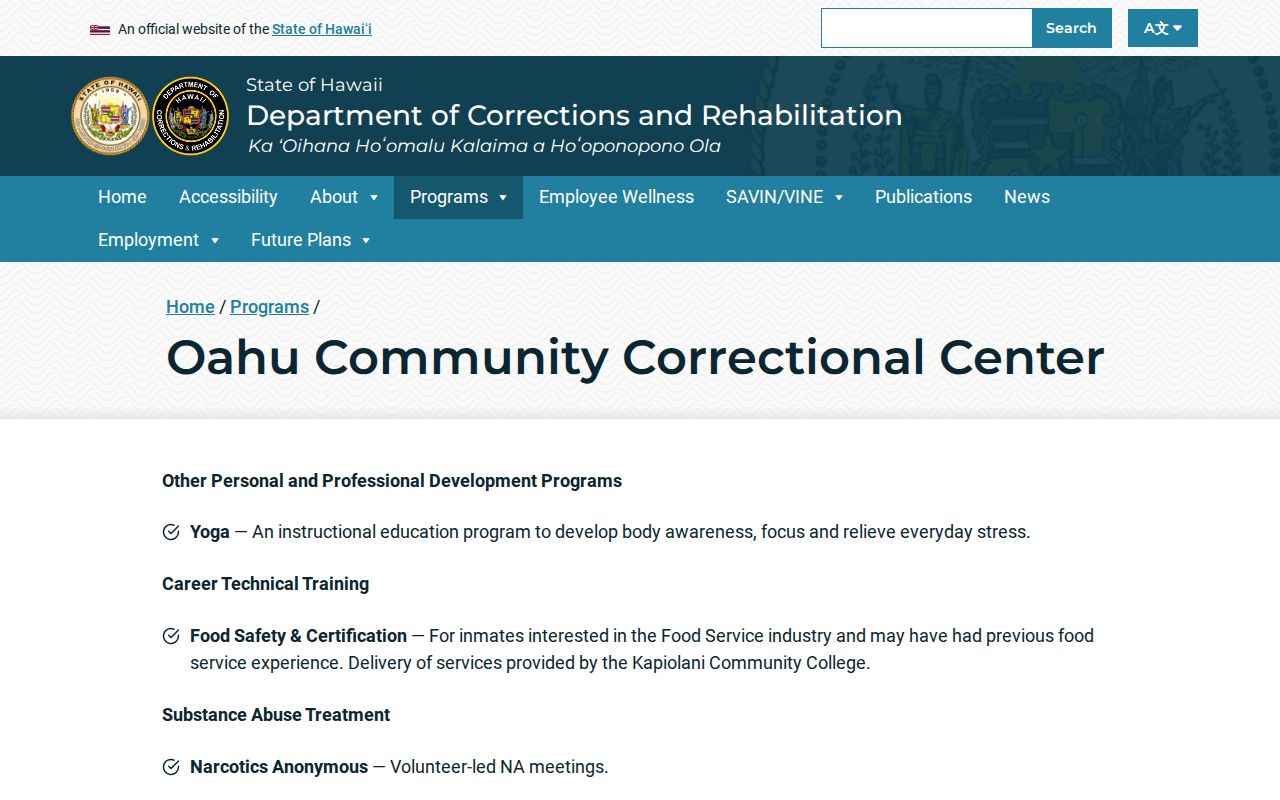
The official OCCC programs page is the source for Laumaka’s reentry setting. The captured image below documents that official program context. It should be read as evidence of program structure, not evidence that a named participant was discharged.
Project Bridge and other reintegration work can help explain why a person’s location or daily schedule differs from a conventional prison placement. The legal status still controls. Ask whether the individual remained committed to DCR on the date at issue, whether a sponsor or program condition applied, and whether a later HPA action set parole. These details turn an imprecise claim that someone was “out” into a defensible status timeline.
Laumaka Release Record Fields
A good Laumaka request separates program movement from final release. DCR’s release policy shows that staff verify identity, review holds, return property and money when applicable, complete required notifications, and update Offendertrak. HRS §353-12 requires the department to maintain records of admission, sentence, parole, discharge, and the papers by which a person was committed or liberated.
| Field | Why it matters |
|---|---|
| Laumaka entry date | Marks program placement, not discharge |
| Legal custody status | Shows whether DCR authority continued |
| Effective parole date | Identifies a shift to HPA supervision |
| Sentence-completion date | Supports final discharge when no other hold applies |
| Destination or receiving agency | Distinguishes community placement from transfer |
The separate release-documentation policy is marked confidential in DCR’s index, so request releasable portions or minimum confirmation fields instead of assuming the full packet is public. Ask DCR to define any code it supplies.
Detainers at Laumaka Release
DCR’s release procedure treats a detainer as a barrier to community release. Staff contact the agency that placed it and do not release the person unless the hold is rescinded or the requesting agency accepts custody. A Laumaka resident can therefore finish a program stage or DCR sentence and still move directly to ICE, USMS, or another authority.
Ask for the receiving authority and effective turnover date. If ICE is named, use the ICE locator, which covers current detainees and certain recently released people. If USMS is named, read the federal docket because there is no public general USMS release locator. A BOP search is useful for sentenced federal custody but does not cover every pretrial movement.
WCCC and the Wider Oʻahu Map
Laumaka is only one part of DCR’s Oʻahu system. WCCC’s 2024 expansion made Hawaiʻi’s only women’s prison a hybrid jail and prison for women, including pretrial and sentenced groups. That fact does not describe Laumaka’s population. It matters because a Honolulu search that checks OCCC and Laumaka alone can miss the correct women’s custody record.
Match the person to the arresting agency, court case, facility, sex, and date. Men approaching release may move among OCCC, Laumaka, Hālawa, and Waiawa, while women may have a WCCC record. Each interfacility move is distinct from discharge. Use the facility field and destination to follow the chain instead of treating the first missing search result as final release.
Projected Dates Versus Laumaka Discharge
OCCC’s Inmate Records Unit computes a tentative date of release from legal documents and pre-confinement calculations. A planned Laumaka placement can form part of release preparation, but the tentative date may change because of amended credit, a later court order, parole action, disciplinary consequences where authorized, or a new hold. Hawaiʻi research found no universal adult rule requiring every prisoner to serve 85 percent, so no such shortcut should be applied.
For an indeterminate sentence, HPA’s minimum-term order and later parole action are central. A tentative parole date marks eligibility for consideration, not a guaranteed exit. For a definite jail term, the court order and DCR computation control. In both cases, the executed DCR movement and destination are needed to confirm what occurred after Laumaka.
Laumaka Property and Release Processing
DCR’s COR.16.02 procedure adds practical detail to the end of a Laumaka custody episode. Before implementing a determined release, staff match the person through identifying information, a photograph or wristband, fingerprints, and questions. State-issued items are collected. Personal property and money are returned as soon as practical, and required registration, DNA, victim-notification, or sponsor steps are addressed when they apply. The agency then updates Offendertrak so the custody change can reach SAVIN.
These steps matter when a person reports missing property or when a public status appears wrong. Contact the releasing facility and DCR records office with the person’s name, custody dates, and a precise description of the disputed item or entry. Request the acknowledgment or releasable supporting field instead of assuming the program office can reconstruct the event by telephone. A SAVIN alert can flag the change, but the signed or executed DCR record is stronger evidence of what staff completed.
Laumaka Court and Parole Evidence
eCourt Kōkua and HPA answer different questions. The court case can show the judgment, sentence, presentence credit, probation order, or later order that shaped confinement. HPA fixes minimum terms for covered indeterminate sentences and decides whether parole is granted. DCR then records the movement from institutional custody. None of those records should be substituted for another.
When the dates conflict, preserve the wording and update date from each source. A court event can be entered after the physical change. An HPA tentative parole date is not a promise of release. A DCR movement can lead to another institution rather than freedom. Ask for the effective action and receiving status, then reconcile it with the sentencing case. This layered check is especially useful at Laumaka because approved time outside the facility can otherwise be mistaken for either probation or parole.
Public Record Search
Sponsored Results