
Where WCCC Releases Go
Women’s Community Correctional Center is both Hawaiʻi’s only women’s prison and an Oʻahu jail site for women. A pretrial release may send someone back to the community after bail, release on recognizance, supervised release, dismissal, probation, or time served. A sentenced prisoner may leave on parole or at maximum sentence expiration. In either group, a detainer can send the person directly to another custodian.
The key question is who had legal custody after the WCCC episode ended. DCR policy requires staff to review holds and contact the agency that placed a detainer. Staff do not carry out a community release unless the hold is withdrawn or the requesting agency takes custody. An entry closing WCCC custody may thus represent transport to ICE, the U.S. Marshals Service, another state, or another DCR institution.
How to Confirm a WCCC Release
Start with the official DCR Hawaiʻi SAVIN page. Follow its VINELink route, select Hawaiʻi, search the person’s name, compare identity details, and open the matching record. Record the exact status, agency, location, and update time. SAVIN covers DCR custody and parole status, but it is not a certified release document and a missing result is not proof of release.
- Decide whether the WCCC stay was pretrial jail custody or a sentenced prison term.
- Check HI SAVIN for the current DCR or parole status.
- For a pending county criminal case, read eCourt Kōkua for bail, dismissal, probation, mittimus, or time-served entries.
- For parole, confirm the effective action with the Hawaiʻi Paroling Authority.
- Ask DCR for the executed release or movement entry when the exact date, time, disposition, or destination matters.
A court order can authorize release without proving the exact time a person left the gate. Likewise, a favorable parole decision or tentative date does not show that release occurred. The strongest confirmation pairs the executed DCR event with the relevant court or HPA record. The broader Honolulu County released-inmate search guide explains these sources in sequence.
WCCC Records and Contact
WCCC is at 42-477 Kalanianaʻole Highway, Kailua, HI 96734. DCR publishes 808-266-9580 as the main number, 808-266-9675 for visitation, and 808-266-9583 as the fax. A facility call can help route a question, but a formal records request is the better channel for a durable release confirmation.
Women’s Community Correctional Center
42-477 Kalanianaʻole Highway
Kailua, HI 96734
Main: 808-266-9580
Visitation: 808-266-9675
Fax: 808-266-9583
Under Hawaiʻi’s Uniform Information Practices Act, send a focused request to the office that maintains the record. Identify the person, WCCC custody episode, approximate dates, and any known DCR or case number. Ask for the admission date, physical release date and time, disposition, destination or receiving authority, and releasable portions of the release checklist or movement history. Request the code definition if the response uses an abbreviation.
DCR headquarters provides UIPA routing at 1177 Alakea Street, Honolulu, HI 96813, phone 808-587-1288 and fax 808-587-1282. The Office of Information Practices forms page supplies the government-record request form. Fees depend on search, review, segregation, and copy format, so request an estimate instead of assuming a flat charge.
WCCC Release Record Fields
DCR’s release workflow produces more detail than a one-word status. A useful WCCC record distinguishes the legal authority for release from the time custody actually changed. It may also show whether another agency accepted the person.
| Field | What it resolves |
|---|---|
| Admission and facility | Which WCCC custody episode the record concerns |
| Legal effective date | When the court, sentence calculation, or HPA action authorized the change |
| Physical release date and time | When WCCC custody actually ended |
| Disposition | Bail, probation, parole, discharge, time served, or another coded outcome |
| Destination or receiving agency | Community release versus continued custody elsewhere |
Some portions may be withheld because they contain personal identifiers, victim information, security material, medical information, or confidential supervision details. HRS §353-12 establishes that DCR maintains admission, sentence, parole, pardon, and discharge records, but it does not make every page of an inmate file public. Ask for reasonably segregable fields.
WCCC’s Hybrid Jail and Prison Role
The distinction between jail and prison is unusually important at WCCC. A person awaiting an Oʻahu court outcome can be housed at the same complex as a sentenced state prisoner. The pretrial path turns on court orders, bail, dismissal, and jail credit. The prison path turns on the judgment, DCR sentence calculation, HPA minimum terms, parole action, and maximum expiration.
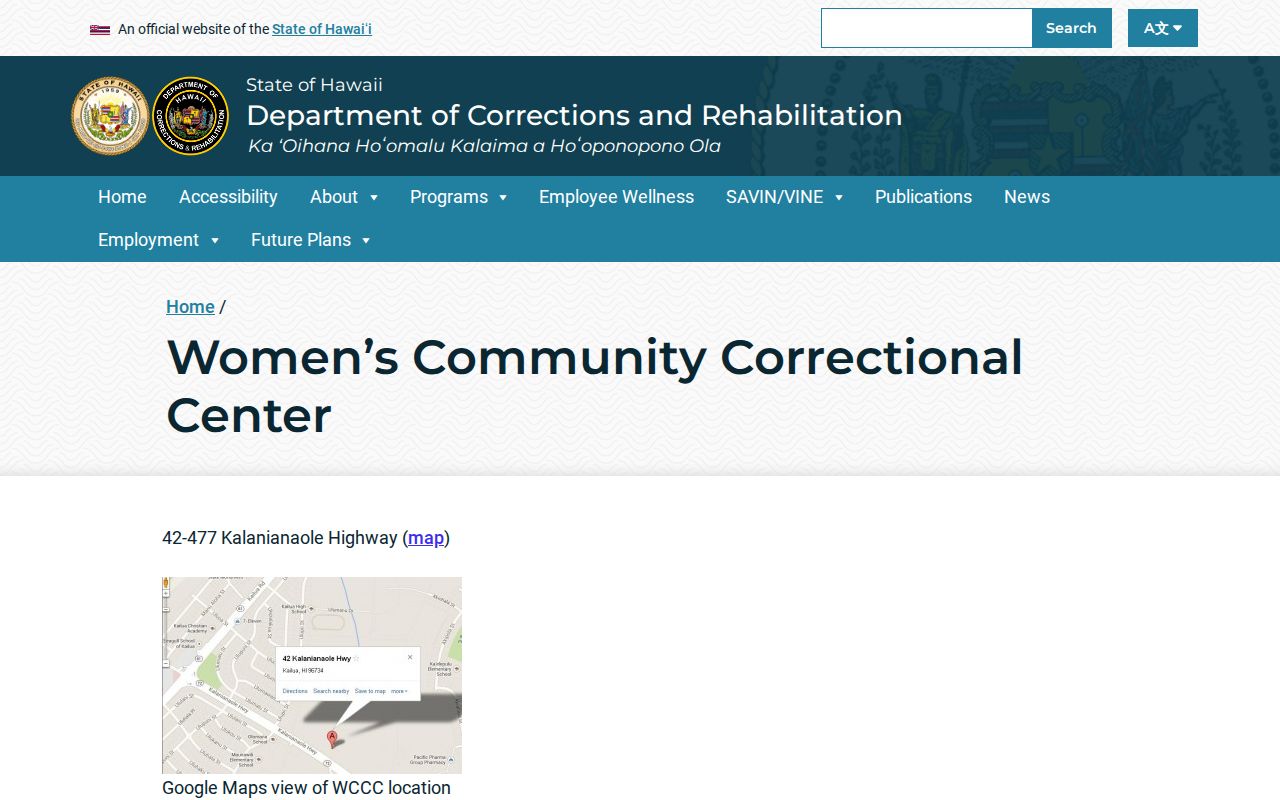
The official WCCC page identifies the facility and its role. This official view helps prevent a common error: assuming every Oʻahu pretrial detainee is at OCCC. It also shows why a WCCC search should begin with the person’s legal status rather than a generic county-jail model.
DCR’s WCCC page provides the facility context shown below.
How the 2024 WCCC Expansion Changed Searches
WCCC’s September 2024 expansion is a distinctive part of Honolulu release research. DCR describes the expanded center as serving pretrial and sentenced women along with several status groups. That change makes WCCC a hybrid prison and jail rather than a prison-only search target.
The DCR expansion announcement is the source for this operational shift.
For older records, specify the exact custody dates. The institution’s role and internal placement can change across time, while the executed admission and release entries remain the best evidence for the episode being researched.
Detainers in WCCC Release Records
A detainer is not a small administrative note. It can determine whether someone walks into the community or is handed to another agency. DCR’s COR.16.02 release policy directs staff to contact the placing agency and prevents release unless the detainer is rescinded or the agency assumes custody.
When a WCCC record lists return to another authority, transfer, or an unexplained code, request the destination and code legend. Then check the receiving system. BOP handles designated federal prisoners, ICE has its own detainee locator, and USMS pretrial custody may be explained by the federal docket. A person can be released from the WCCC record while remaining confined elsewhere.
Property, Money, and Status Updates at WCCC Release
DCR policy links the paper record to practical release steps. Staff verify identity through identifying information and institutional records, collect state-issued property, return personal property and money as soon as practical, complete required notices, and update Offendertrak immediately. If Offendertrak is unavailable, staff must make a call so SAVIN notification can occur.
This process explains why a SAVIN alert may be the quickest public clue yet still not serve as the final record. A missing item or incorrect entry should be raised with WCCC and DCR records using the person’s custody episode and release date. Ask for the supporting acknowledgment or correction process rather than relying on an oral recollection.
Public Record Search
Sponsored Results
WCCC Court and Parole Evidence
WCCC’s mixed population makes the source of legal authority especially important. For a pretrial detainee, eCourt Kōkua may show bail, release on recognizance, supervised release, dismissal, probation, time served, or a commitment order. Those entries explain why the WCCC episode changed, but a court order is not the same as the time recorded at the facility door. Check the DCR movement entry for the physical event and any destination.
For a sentenced woman, the Hawaiʻi Paroling Authority establishes minimum terms for covered indeterminate sentences and decides parole. A tentative parole date marks the expiration of the longest controlling minimum for consideration. It is not a promise that the person left WCCC on that date. Confirm a parole grant with the effective HPA action and DCR release event. If parole was denied or deferred, confinement may continue until a later hearing or maximum expiration.
eCourt Kōkua also has limits. Some older District criminal cases before August 2012 may not appear online, and confidential, juvenile, or sealed matters are excluded. A missing image icon does not prove that a public document is unavailable from the clerk. Search by full name and case details, review aliases and event chronology, and obtain a clerk copy when the online docket cannot resolve the order. Matching the court authority to the executed DCR event separates an expected release from the event that actually occurred.