
Waiawa Prison Release Paths
Waiawa Correctional Facility is a DCR minimum-security male prison on Oʻahu, not a Honolulu County jail. People there are serving state sentences. A final release may occur through parole or maximum sentence expiration. A move to Hālawa, OCCC, Laumaka, an off-island placement, or another government authority is an institutional or custodial transfer instead.
Waiawa’s minimum-security and reentry orientation makes it especially important not to turn proximity to release into proof. Approved programs, community preparation, an HPA hearing, and a tentative date can all occur while DCR retains custody. Ask for the executed movement date, disposition, and destination. If the disposition is parole, obtain the HPA action. If it is discharge, seek the sentence-completion record. The Honolulu released-inmate records guide explains the full source chain when the last facility is uncertain.
Confirm a Waiawa Release
Open the official Hawaiʻi SAVIN page and follow the VINELink route. Search the name, compare available identity details, and copy the exact status, agency, facility, and update date. HI SAVIN supplies custody and parole information for people under DCR jurisdiction. It is not a certified historical discharge archive, and no result does not prove release.
- Check HI SAVIN. Match the right person and preserve the live wording.
- Review HPA evidence. Request the releasable action and effective date for a claimed parole.
- Read eCourt Kōkua. Check the judgment, sentence, credit, and later court orders.
- Ask DCR for execution. Request Waiawa’s movement date, disposition, destination, and releasable hold fields.
These sources answer separate questions. HPA decides parole, the court supplies the sentence, and DCR records the custody event. Agreement among them is stronger than any single projected date.
Waiawa Records and Contact
DCR lists Waiawa at 94-560 Kamehameha Highway, Waipahu, HI 96797. It also publishes P.O. Box 1839, Pearl City, HI 96782. Visitation information is available at 808-677-6150, and the published fax is 808-677-6155. The visitation line is not a substitute for a written historical release request.
Waiawa Correctional Facility
Street: 94-560 Kamehameha Highway, Waipahu, HI 96797
Mail: P.O. Box 1839, Pearl City, HI 96782
Visitation: 808-677-6150
Fax: 808-677-6155
DCR’s UIPA routing contact is 1177 Alakea Street, Honolulu, HI 96813, telephone 808-587-1288 and fax 808-587-1282. Identify the person, DCR number where available, Waiawa date range, and requested fields. Ask for electronic delivery and an advance estimate. Basic dates, facility, and disposition may be more readily segregable than confidential supervision, victim, security, medical, or personal information.
Waiawa Release Record Fields
HRS §353-12 requires DCR to establish records of admission, sentence, parole, pardon, discharge, and related events and to preserve the official papers through which a person was committed, paroled, liberated, or retaken. That statute supports a precise confirmation request. It does not declare every part of the inmate file open to the public.
| Field | Question answered |
|---|---|
| Effective movement date | When Waiawa custody changed |
| Disposition code | Whether DCR recorded parole, discharge, transfer, or another result |
| Destination | Community supervision, another prison, program, or agency |
| Parole action | Whether HPA authorized release and its effective date |
| Detainer result | Whether another custodian assumed control |
Ask DCR to define every abbreviation. Codes such as PAR, DISC, or return-to-other-authority wording should not be translated from memory. Since DCR’s policy index marks release documentation confidential, request minimum releasable fields or segregable portions instead of demanding the full packet.
Waiawa Projected Dates and Parole
A tentative parole date is tied to expiration of the longest controlling minimum for parole consideration. It does not guarantee release on that date. HPA fixes minimum terms for covered indeterminate sentences and later acts on parole. The judgment’s maximum term remains important. Mandatory minimums, institutional conduct, a pending Hawaiʻi felony, specified offense categories, and lack of an approved parole plan can affect the parole decision under the researched legal framework.
Research found no universal Hawaiʻi adult rule requiring every prisoner to serve 85 percent and no general earned-time shortcut that can replace case-specific analysis. Use HRS §§706-669 and 706-670, the judgment, any mandatory-minimum authority, HPA’s minimum-term order, and the current board action. Waiawa planning may use a projected date, but a hold, amended credit, new order, or parole decision can change the outcome.
Waiawa Detainers and Transfers
DCR’s release procedure directs staff to review detainers and contact the placing agency. A person is not released to the community unless the hold is rescinded or the requesting authority accepts custody. Thus, the end of a Waiawa sentence can lead directly to ICE, USMS, another jurisdiction, or a different lawful custodian.
Request both the hold disposition and receiving authority. ICE’s locator serves immigration custody and certain recently released records, subject to its limits. USMS has no general public name-level release locator, so the federal docket may be necessary. BOP’s locator serves federal imprisonment and historical federal releases, but a “Released” result only means the person left BOP custody. It does not rule out DCR, ICE, or later custody. Follow each documented handoff until the destination is clear.
Waiawa Records Retention Context
The successful project image comes from the official State Archives retention schedule directory. It establishes where DCR’s agency schedule is published. The image does not justify assigning one universal retention period to every Waiawa release document.
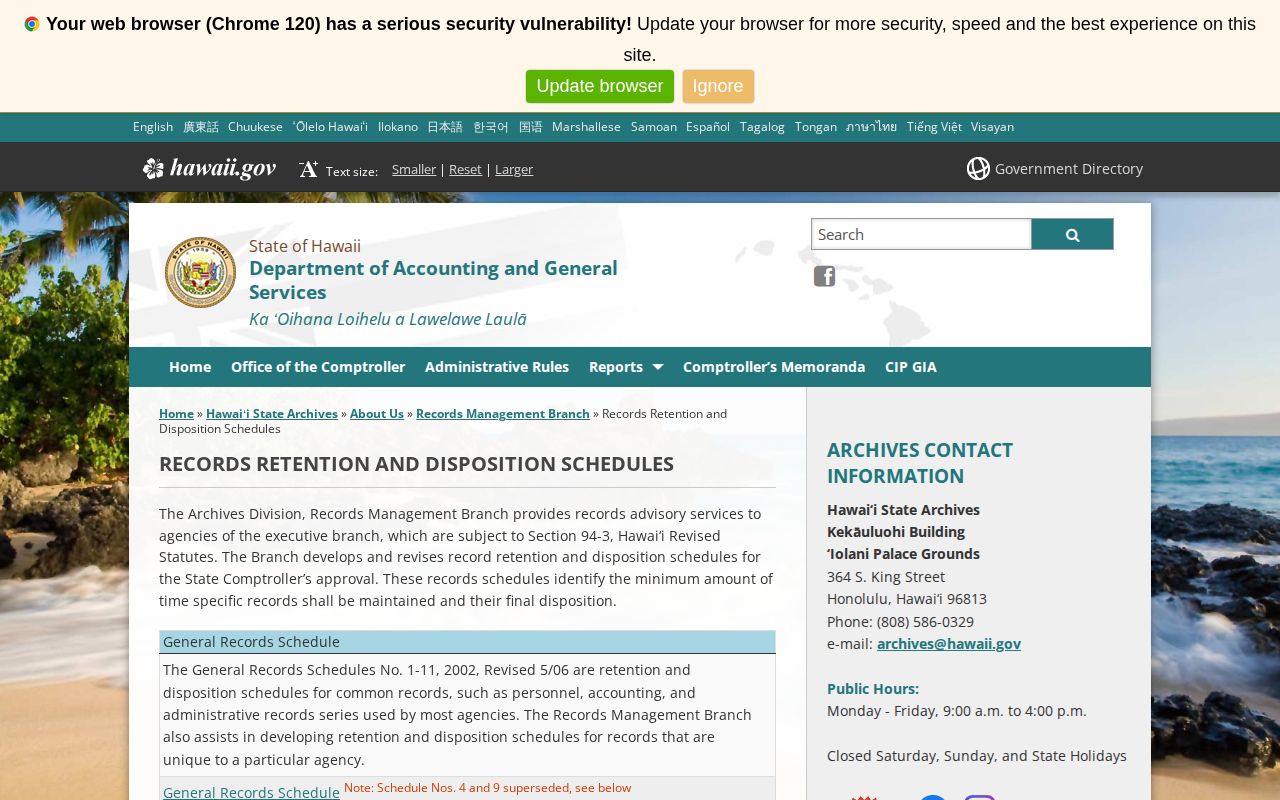
DCR ADM.05.02 describes access at department offices and retains its request form for at least three years. That period concerns the request record, not the prison file. The scanned agency schedule was not clear enough in the research to publish a reliable number for every release record. State the person, facility, date range, and record type, then ask DCR whether the item exists and in what format.
WCCC Is a Different Oʻahu Path
WCCC’s 2024 expansion made Hawaiʻi’s only women’s prison a hybrid jail and prison for Oʻahu women. That history does not apply to Waiawa, a male minimum-security prison. It is included as a lookup safeguard because an Oʻahu search limited to Waiawa, Hālawa, and OCCC can miss the correct record for a woman held at WCCC.
Match the person by DCR identifier, sex, court case, facility, and date range before asking for a release. Men may move between Waiawa, Hālawa, OCCC, Laumaka, or another placement. Women may have WCCC jail and prison history. Every interfacility move should remain labeled as a transfer unless the disposition and destination show community release. This facility-specific approach avoids applying one institution’s population or history to another.
Waiawa Property and Status Corrections
COR.16.02 directs staff implementing a release to verify identity, collect state-issued property, return personal items and money as soon as practical, address applicable registration and notification steps, and update Offendertrak immediately. If the system is unavailable, a contingency supports SAVIN notice. Those steps can create useful acknowledgments when a public status or property account is disputed.
For an incorrect Waiawa entry, identify the custody episode and the exact field believed wrong. For missing property, describe the item and release event. Contact the facility and DCR records office, then request the releasable supporting record or correction process. A SAVIN alert is a useful prompt, but the maintained DCR document is stronger evidence of what staff executed.
Waiawa Court Evidence After Release
eCourt Kōkua can preserve the sentencing trail after a person leaves Waiawa. Search by party name, compare aliases and identifiers, and review offenses, events, dockets, judgment, disposition, and later orders. Court labels such as ACTIVE, INACTIVE, or CLOSED describe the case, not the person’s physical custody. A missing PDF can mean that a clerk copy exists.
Use court evidence to establish legal authority, HPA evidence to establish parole action, and DCR evidence to establish execution. Older District criminal matters may not be online, while sealed, juvenile, and confidential records are excluded. When sources conflict, record their dates and wording, then ask DCR for the effective movement record rather than assuming the newest visible webpage is complete.
Public Record Search
Sponsored Results