
Where FDC Honolulu Releases Go
Federal Detention Center Honolulu is a Federal Bureau of Prisons detention facility at 351 Elliott Street in Honolulu. It holds people in the federal system, including people whose custody is tied to court proceedings. A person may leave for the community after a qualifying bond or release order, move into federal supervision after confinement, transfer to another BOP institution, or pass to another sovereign.
The word “release” must be bounded to the agency reporting it. A BOP release closes BOP custody. It does not rule out a USMS movement, ICE detention, a Hawaiʻi warrant, or later custody. The receiving authority and federal docket are vital when the locator no longer lists a facility.
How to Confirm an FDC Honolulu Release
Open the BOP Inmate Locator. Search by BOP register, DCDC, FBI, or INS number when available. A name search can use first, middle, and last name plus age, race, and sex filters. Compare the result carefully and preserve the exact release date and location wording.
- Identify the person with a federal number or enough biographical detail to avoid a name match error.
- Read the BOP result for location and release date.
- Check the federal District of Hawaiʻi docket for bond, detention, sentencing, or release orders.
- If transfer or a hold is possible, check the receiving authority rather than treating absence as freedom.
- Request an official record when a locator screen is not enough for the question.
BOP records for federal inmates incarcerated from 1982 to the present can show a former prisoner’s release date. USMS pretrial detention does not always produce a standard BOP history before designation, so the criminal docket can be the stronger source for a pretrial release. The Honolulu County release lookup explains when state and federal channels diverge.
Reading BOP Released Results
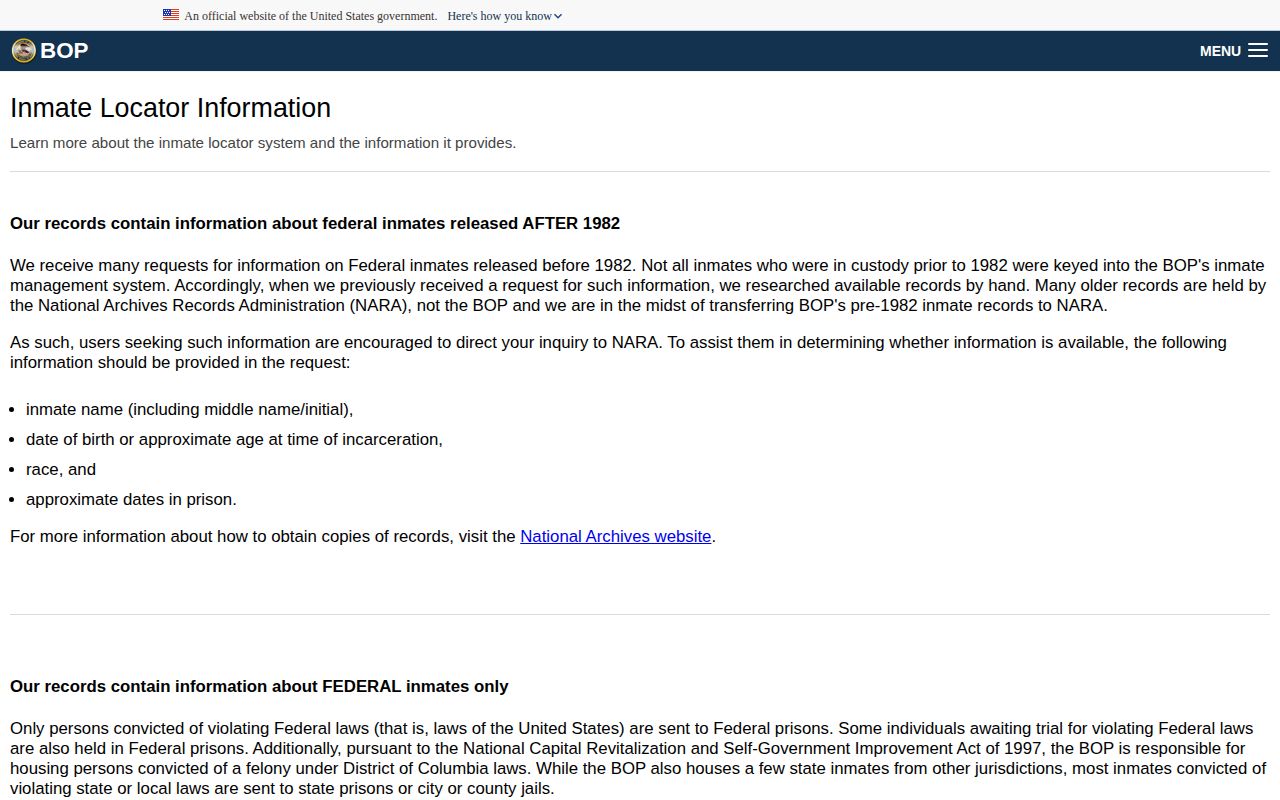
BOP’s interpretation guidance makes the locator language more precise. A past release date paired with no facility location, or a location displayed as “RELEASED,” means the person is no longer in BOP custody. It does not prove that all legal restraint ended.
| BOP field | What it can show |
|---|---|
| Name and register number | The federal identity attached to the result |
| Age, race, and sex | Descriptors used to distinguish similar names |
| Location | A current BOP facility or a released status |
| Release date | The reported end of that BOP custody episode |
The BOP locator records guide is the source for interpreting former-prisoner results.
Projected dates can change after recalculation, including First Step Act adjustments. Treat a future date as a projection and a past released result as evidence tied to BOP, then corroborate the legal event.
FDC Honolulu Records and Contact
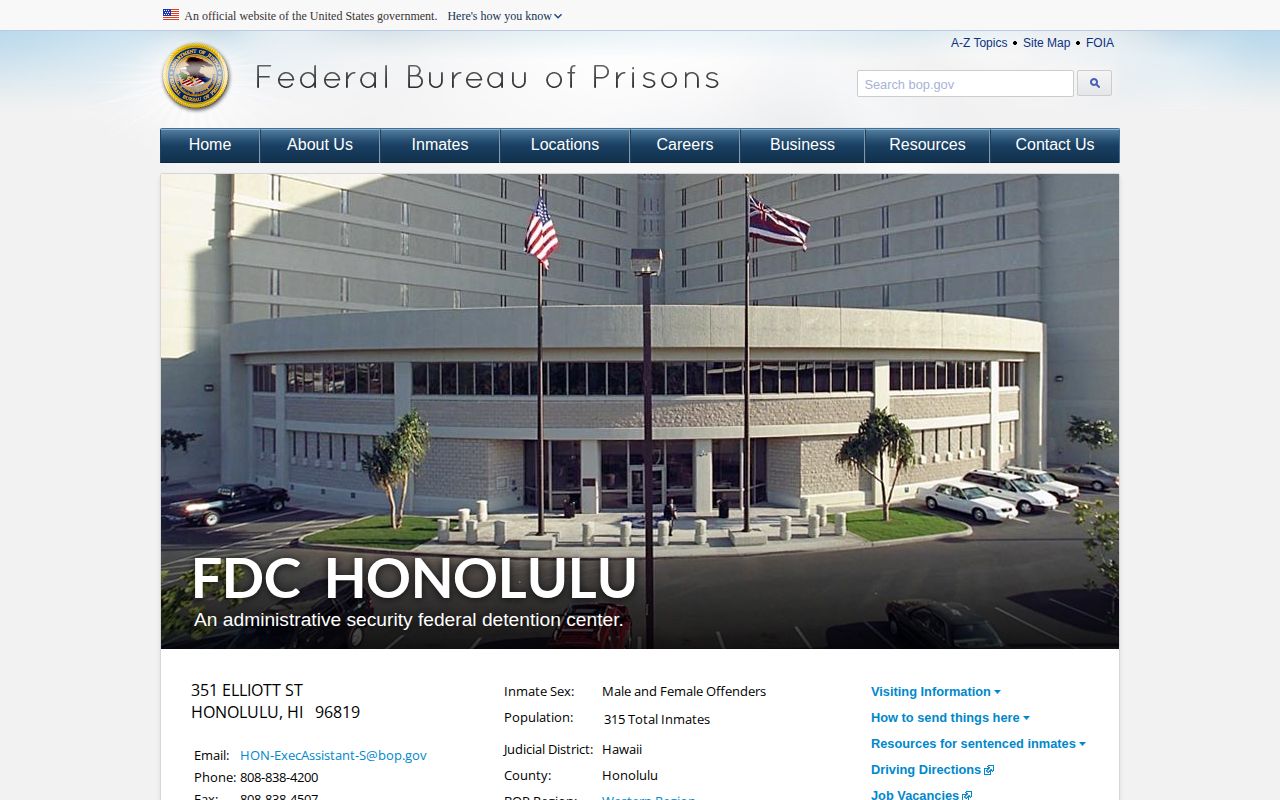
FDC Honolulu is at 351 Elliott Street, Honolulu, HI 96819. The published telephone number is 808-838-4200. The facility can route operational questions, but staff may not disclose another person’s protected information by phone.
Federal Detention Center Honolulu
351 Elliott Street
Honolulu, HI 96819
Phone: 808-838-4200
BOP’s official FDC Honolulu page supplies the facility identity and current agency information.
For a maintained federal record, BOP uses federal FOIA and Privacy Act processes. A request should identify the person, register number, custody dates, facility, and the precise record or field wanted. Third-party requests can face privacy withholding. Court orders and certified docket records come from the federal court rather than BOP.
FDC Honolulu Court Release Records
The District of Hawaiʻi docket can explain why federal detention ended. It may contain an order of release, bond conditions, detention findings, judgment, sentence, commitment, or later supervision activity. A court order can authorize release, but it may not record the exact moment the person physically left FDC Honolulu.
PACER provides federal docket access, and the District of Hawaiʻi clerk is the court source for official copies. Read the newest order in context. An order in one case may coexist with another matter or detainer. A sentence entry may also direct continued federal imprisonment at another institution instead of community release.
ICE Custody at FDC Honolulu
ICE’s own detention-facility material lists FDC Honolulu, confirming that immigration detainees can be held in the federal building. This overlap is a central local caution. Someone can leave BOP criminal custody yet remain at the same physical institution or move under ICE authority.
ICE’s Online Detainee Locator System covers current detainees and, according to ICE’s attorney resources, people released from ICE custody within the last sixty days. Search by nine-digit A-number plus country of birth, padding a leading zero when needed, or use exact biographical information and country of birth. People under eighteen are not displayed. Spelling, recent processing, security exclusions, and the time window can all produce no result.
If online search fails, ICE’s Detention Reporting and Information Line is 1-888-351-4024, Monday through Friday from 8 a.m. to 8 p.m. Eastern. An ICE result answers immigration custody, not the outcome of the federal criminal case.
USMS Transfers from FDC Honolulu
The U.S. Marshals Service manages many federal prisoner movements, but the District of Hawaiʻi has no public general detainee or release locator. A person held for court may move under USMS authority without a clean public BOP trail. The federal docket, attorney, and court clerk are the useful public-facing sources for bond and release orders.
For a sentenced prisoner, BOP becomes the main locator after designation. For a person on federal supervised release, U.S. Probation is distinct from BOP confinement. These systems should not be blended into one “federal jail” status.
Detainers and FDC Honolulu Release Meaning
A detainer can turn the end of one custody episode into the beginning of another. If the docket, BOP result, or record mentions ICE, USMS, Hawaiʻi DCR, or another jurisdiction, follow that agency’s locator or records channel. Do not infer community release from a closed facility location.
The same principle applies in reverse. A DCR record that says a person was returned to another authority may point to FDC Honolulu without proving the person entered ordinary sentenced BOP custody. Build the custody timeline agency by agency, using dates and exact status language.
When the destination is unclear, request the movement date, receiving agency, and authority for the transfer. Compare those details with the next agency’s first custody entry. Matching the end of one episode to the start of the next is stronger than relying on an empty locator result. It also separates a true release from transport for court, designation, immigration processing, or service of another sentence.
Agency Records Complete the Custody Timeline
A reliable timeline uses the identifier, case number, exact dates, and exact agency wording rather than name alone. Compare the last event held by this custodian with the first event held by the next one. A court order may authorize release without recording the physical exit time, while a locator status may describe only one agency. A transfer, designation, detainer pickup, or processing delay can explain why dates do not align.
When public search results leave a gap, request the maintained movement fields from the agency that controlled that stage. Ask for assumption of custody, facility, transfer or release date and time, disposition, destination, and receiving authority. Court documents come from the court, BOP and ICE records use federal FOIA or Privacy Act channels, and HPD or DCR records use the applicable Hawaiʻi process. Third-party requests may face lawful privacy limits.
For a federal pretrial matter, also compare the detention hearing, bond order, judgment, and later supervision entries. USMS movement may not appear in a standard BOP history before designation. For an HPD episode, retain the report number, arrest time, disposition code, and next working-day court event. These details help distinguish release after processing from transport to OCCC.
Preserve each result with its source and update time. Do not merge a BOP release, ICE result, HPD disposition, and DCR movement into one unqualified status. Matching the end of one custody episode to the beginning of the next distinguishes community release from continued confinement and gives the record holder a precise issue to confirm.
Public Record Search
Sponsored Results