
OCCC Release Paths in Honolulu
Oʻahu Community Correctional Center is a Hawaiʻi Department of Corrections and Rehabilitation jail, not a Honolulu County sheriff’s jail. It holds pretrial detainees, people serving short terms, and sentenced felons in transition. A person may leave OCCC after bail or bond, release on recognizance, supervised release, dismissal, time served, or a probation order. Each can end confinement on the case that brought the person to OCCC. The release entry should still be read for its actual disposition and destination.
A movement to Hālawa, Waiawa, WCCC, Laumaka, an off-island institution, or another government agency is a transfer, even if OCCC marks the person out of its own count. The court docket helps explain bail, dismissal, probation, sentence credit, or a new mittimus. HI SAVIN can supply a current custody or parole clue, while DCR’s inmate file is the direct source for the executed movement. The broader Honolulu released-inmate search and records guide explains how those sources fit together for a named person.
Confirm an OCCC Release
Begin with the official Hawaiʻi SAVIN page, then open the linked Hawaiʻi VINELink search. Search the name with any available identity details, select the right record, and record the exact status, agency, location, and update shown. SAVIN covers offenders under DCR jurisdiction, but it is a notification and custody system rather than a certified release certificate. A missing result can reflect spelling, a transfer, older data, or an agency update issue.
- Check HI SAVIN. Compare identity details and note whether OCCC, another DCR facility, parole status, or an out-of-custody result appears.
- Read eCourt Kōkua. Match the person and case, then review bail, events, dockets, dispositions, judgment, sentence, and probation information.
- Distinguish release from movement. Do not call an OCCC-to-prison placement a community release.
- Request the maintained record. Ask DCR for the effective release or movement date, facility, disposition, and destination for the defined custody episode.
The court record is durable but does not always show the moment someone walked out. A release order may precede processing, and an online docket entry may post later. The executed DCR movement entry is therefore the best way to confirm the physical custody change.
OCCC Records and Contact
DCR identifies OCCC at 2199 Kamehameha Highway, Honolulu, HI 96819, with a main number of 808-832-1777. The number can route a current facility question, but a formal historical confirmation is better sent to the agency office that maintains the inmate file. DCR’s headquarters and UIPA routing contact is 1177 Alakea Street, Honolulu, HI 96813, telephone 808-587-1288 and fax 808-587-1282. Verify current routing on the official directory before sending personal information.
Oʻahu Community Correctional Center
Address: 2199 Kamehameha Highway, Honolulu, HI 96819
Main phone: 808-832-1777
Operator: Hawaiʻi Department of Corrections and Rehabilitation
Record route: DCR UIPA office and the OCCC inmate record
A narrow request should give the full name, an identifier or date of birth if lawfully available, the OCCC date range, and the requested fields. Useful fields include admission date, release or transfer date and time, release disposition, destination or receiving authority, and the releasable part of the release-status form. Ask for electronic delivery and an advance fee estimate. Privacy, victim, security, medical, and supervision information may be withheld or redacted under Hawaiʻi law.
OCCC Jail Role and Records
The official OCCC facility page describes the center’s role and contact details. The successful project image below preserves that official source view. It helps establish why an OCCC check must follow a jail path even though the same state department also operates prisons.
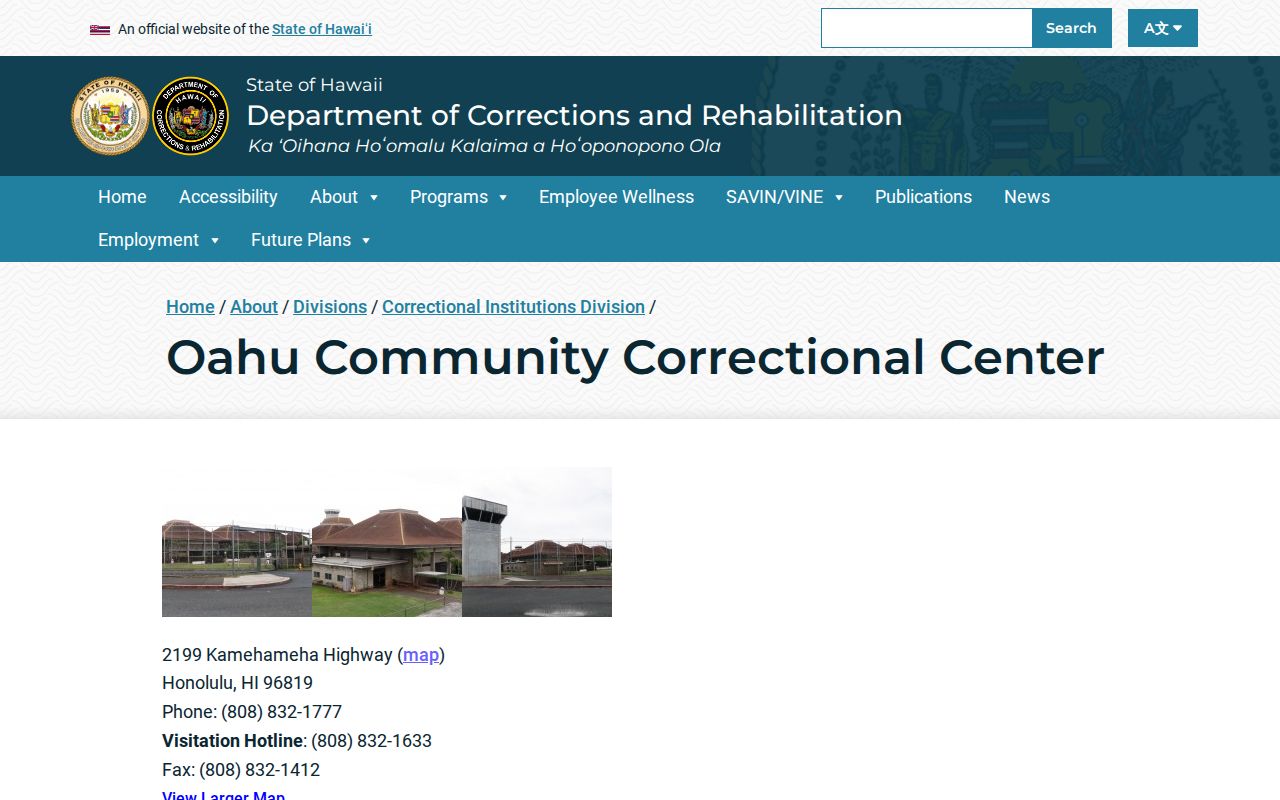
DCR describes OCCC as the largest jail facility in Hawaiʻi and reports a 950-bed facility. That figure describes the institution, not a daily population or a release count. Its Inmate Records Unit computes pre-confinement calculations and a tentative date of release, processes legal papers supporting release, updates active and inactive files, and serves as an archive depository for inactive inmate records. A tentative date remains a calculation. The executed entry, court authority, and any receiving custodian determine what actually happened.
What an OCCC Release Record Shows
DCR’s published release procedure gives a concrete picture of the file behind an OCCC exit. Staff verify identity through name, identifying data, picture or wristband, fingerprints, and questions. They collect state-issued items, return personal property and money as soon as practical, review holds, complete needed notifications, and update Offendertrak immediately. If the system is unavailable, staff must use a contingency so SAVIN notification can occur.
| Requested field | What it can establish |
|---|---|
| Effective date and time | When DCR implemented the custody change |
| Disposition | Bail, bond, recognizance, dismissal, time served, probation, transfer, or another coded result |
| Releasing facility | Whether the event occurred at OCCC rather than a police cellblock or prison |
| Destination | Community, program, DCR institution, or receiving authority |
| Hold review | Whether another agency’s detainer affected the exit |
HRS §353-12 requires DCR to establish records of admission, sentence, parole, pardon, discharge, and related events and to preserve official commitment and liberation papers. The statute proves that DCR records release information. It does not make every part of a release packet public, so the request should ask for reasonably segregable fields.
OCCC Detainers Change Release Destinations
A detainer is the clearest reason that “released by OCCC” may not mean released into Honolulu. DCR policy instructs staff to contact the agency that placed the hold. OCCC does not release the person to the community unless the detainer is rescinded or the requesting authority takes custody. The next custodian might be ICE, the U.S. Marshals Service, another state or county authority, or a different lawful agency.
Ask for both the disposition and destination. If the record identifies a receiving authority, continue with that authority’s channel. ICE’s locator covers immigration custody, while BOP’s locator covers federal prisoners and certain historical federal records. A U.S. Marshals pretrial placement may require the federal docket because there is no general public USMS detainee locator. Court language such as a release order also does not cancel an unrelated hold unless the record says so.
OCCC Is Not the Only Oʻahu Jail Path
Honolulu searches often begin at OCCC, but DCR’s system has an important sex-specific distinction. The 2024 Women’s Community Correctional Center expansion made WCCC Hawaiʻi’s only women’s prison and a hybrid prison and jail for Oʻahu women. WCCC can hold pretrial detainees as well as sentenced women. A search that assumes every Oʻahu pretrial admission passes through OCCC may therefore miss the correct facility and inmate file.
Use the arresting agency, court case, sex, admission date, and facility field to identify the right custodian. If the court record concerns a woman and OCCC has no matching episode, ask whether WCCC maintained the admission. The point is not to apply WCCC’s expansion facts to OCCC. It is to avoid treating OCCC as the sole jail record holder in a unified state system. Likewise, HPD release before DCR intake belongs in the police arrest and release record, not an OCCC file.
OCCC and Laumaka Custody Status
OCCC manages Laumaka Work Furlough, and DCR describes reintegration programs that can place a person in the community for approved activity. That physical access does not by itself establish release from DCR legal custody. A participant may remain committed, return to the facility, move later to parole, or complete the sentence on another date. Program participation is best treated as a status clue.
Ask DCR for the legal custody status on the date at issue, the facility or program assignment, and the effective parole or discharge date. Sponsor or program verification may appear in the release workflow for supervised placements. If the person later entered parole, Hawaiʻi Paroling Authority records can explain the parole action and terms, while the DCR executed movement confirms the custody event. Keeping those records separate prevents a work day outside Laumaka from being mislabeled as final discharge.
Public Record Search
Sponsored Results