No Honolulu 24-Hour Feed
No City and County of Honolulu or DCR page publishes a rolling list of people released during the last 24 hours. Hawaiʻi DCR operates Oʻahu’s jail, so the usual county sheriff feed does not exist. HI SAVIN is person-specific, not a browsable daily report.
The closest timely public trace is the HPD arrest-log page. Its dispositions can show release pending investigation, bail, or transfer to OCCC. A police log does not prove release from later DCR custody.
Verify the custodian: release from HPD, release from DCR, and transfer to another authority are different events.
Check Honolulu Releases Today
Begin with the agency that held the person. A missing search result is only a clue.
- Inspect HPD’s current arrest log for a police arrest and decode the disposition.
- For OCCC, WCCC, or prison custody, search the named person through HI SAVIN.
- Read the criminal case in eCourt Kōkua for bail, release orders, dismissal, sentence, or commitment.
- Submit an OIP UIPA request to HPD or DCR when public sources do not settle the event.
- Check any receiving agency named in a detainer or transfer entry.
DCR policy requires an immediate Offendertrak update and a SAVIN contingency call if the system fails. It does not promise a public update interval.
Honolulu Daily Release Fields
No official feed supplies a fixed field set. A focused request should ask for the minimum facts needed to identify the event and should request the definition of any agency code.
| Field | Purpose |
|---|
| Name and identifier | Separates similar names |
| Releasing facility | Identifies HPD, OCCC, WCCC, or a prison |
| Actual date and time | Places release inside the daily window |
| Disposition | Distinguishes bail, dismissal, time served, parole, probation, or transfer |
| Receiving authority | Shows whether custody continued elsewhere |
A booking, report, or case number can improve the search. DCR may redact exempt material, but it must consider reasonably separable public fields under UIPA.
Request Honolulu Release Records
Historical HPD logs rotate off the public page after fourteen days. HPD policy directs requesters to the Records and Identification Division with the dates wanted. A written UIPA request may produce a fee estimate. Telephone and walk-in demands do not replace that process.
DCR requests route through the Office of the Director at 1177 Alakea Street, Honolulu, phone 808-587-1288. Ask for the actual release time, facility, disposition code and definition, and destination. Use the 72-hour release list process for a wider window or the Honolulu released-inmate search for one named person.
Honolulu Release Versus Custody
A release from an HPD cellblock may mean citation, bail, or completion of police processing. Transport from HPD to OCCC is admission to DCR, not freedom. Likewise, a DCR release entry may identify parole, probation, sentence completion, or transfer under a federal or immigration hold.
A released person often drops from a current-custody search. Someone still shown at a facility may await processing or transport. The executed movement record and receiving-agency check resolve the difference.
How Honolulu Releases Are Processed
DCR’s release procedure requires identity checks, collection of state items, return of property and money, sponsor verification for supervised release, and hold review. A detainer blocks community release unless withdrawn or the placing agency takes custody.
At HPD Central Receiving, bail is handled through the Adult Release entrance behind Alapaʻi station. HPD describes cash or bond procedures and estimates about thirty minutes for bailout processing, but the estimate is not a guarantee. Check the current Central Receiving instructions.
No Honolulu Mugshot App
No verified Honolulu sheriff app or recent-release mugshot app exists. VINELink is the official mobile option for DCR custody and parole alerts, not a stream of everyone released today.
HPD’s arrest-log screen shows the official police trace used when no county feed exists.
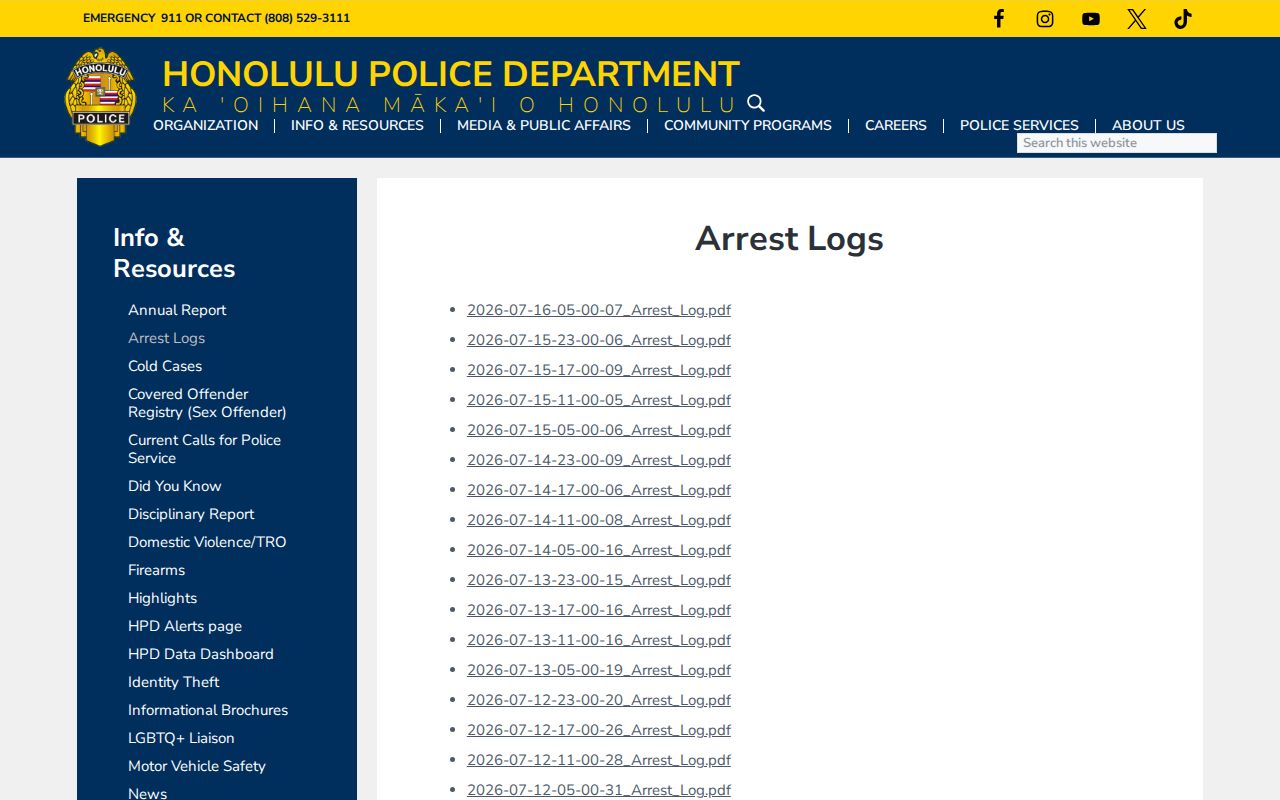
The disposition still must be matched to the correct custody episode.
Read Honolulu Police Dispositions
HPD’s arrest logs are useful because they include the event date, report details, arrest information, and a disposition code. The disposition is the key to a same-day inquiry. Released pending investigation, bail, and transport to OCCC do not mean the same thing. A transfer to OCCC starts a DCR custody episode. It should never be counted as release from the jail.
The public logs are downloadable PDFs, not live custody records. They report police processing and can change through later court or agency action. Match the arrest report number and name to the court docket. Then use HI SAVIN or DCR records if OCCC appears in the chain. This prevents a police release from being confused with a later jail release.
When a code is unclear, consult HPD’s code key or ask Records and Identification to define it. Keep the agency’s wording in the notes. A short code should not be translated into a broad claim about freedom, sentence completion, or supervision.
Honolulu Daily Release Types
A DCR release record may describe bail, bond, release on recognizance, supervised release, dismissal, probation, time served, parole, discharge, or return to another authority. These outcomes have different legal effects. Bail and release on recognizance generally end confinement while the case continues. Time served means the confinement ordered in that matter has been credited as complete. Probation and parole place the person under different forms of supervision.
Transfer terms require the most care. A move from OCCC to Hālawa, Waiawa, WCCC, Laumaka, or an out-of-state prison is continued correctional custody. Pickup under an ICE, USMS, or other detainer is also continued custody under a different agency. DCR policy requires staff to contact the agency that placed the hold and prevents community release until the hold is rescinded or that agency takes custody.
- Recognizance
- Court-authorized release without posting a cash bond, subject to the order.
- Time served
- A disposition crediting confinement already completed toward the ordered jail term.
- Detainer
- A request by another authority to hold or transfer the person.
- Discharge
- A formal end to the relevant custody or supervision status.
Confirm Honolulu Daily Results
A same-day result should answer who acted, when the action became effective, and where the person went. Compare at least two official sources when possible. The court can explain the legal authority. DCR can confirm the facility action. HI SAVIN can provide a prompt status clue. HPD can document a police-cellblock disposition.
Record the time of each check. Dynamic results can change, and a docket event may lag behind the door event. If the sources disagree, ask for the executed release checklist or equivalent movement entry and the disposition-code definition. DCR’s release procedure identifies Release Status Form DCR 8281 as part of the process, though the separate release-documentation policy is confidential. A requester should seek the releasable portions, not promise access to the entire packet.
HRS §353-12 requires DCR to maintain records of admission, parole, pardon, and discharge. That confirms the record exists. Public access still proceeds under UIPA and may involve lawful redaction. A precise one-day request gives the agency a clear scope and helps separate the desired fields from protected material.
Note: A current screen is a clue, while the executed agency record confirms the event.
Match Honolulu Release Identity
Use the full name, date of birth, report number, case number, or DCR identifier to separate similar records. HPD and DCR may assign different numbers to related parts of the same event. Preserve each number with its agency.
Compare aliases in eCourt Kōkua and check the arrest or admission date. A photograph can help identify a booking event, but it cannot establish current custody or the release time. When identity remains uncertain, request agency confirmation instead of joining records by name alone.
Keep the result purpose-neutral and factual. The useful conclusion is that a named person left a specified custodian at a stated time and under a stated disposition, subject to any receiving authority.
HPD Central Receiving also publishes separate custody-information and cellblock contacts. Those lines can confirm which police station handled a short-term hold, but historical log research still requires the written Records and Identification process. A phone response should not be treated as a substitute for the maintained arrest or release record. When transport to OCCC is reported, begin a new DCR custody check and obtain the later facility disposition.
For an OCCC event, request the actual DCR movement entry after checking the police log. The movement record can show whether the person left on bail, recognizance, dismissal, time served, probation, or another disposition. It can also identify a transfer to a prison or receiving agency. That second check is essential because an HPD code showing transport to OCCC begins custody instead of ending it.
Public Record Search
Sponsored Results