
Honolulu Booking Photos and Release
HPD policy treats mug photographs as public records under Office of Information Practices guidance, subject to case-specific limits. Its operating rule generally permits release for one year after arrest when no nonconviction disposition or expungement controls. After one year, HPD generally ties disclosure to a conviction or active prosecution while preserving OIP review.
The live HPD photograph policy controls. No Hawaiʻi statute was verified that compels blanket online publication, and no current state anti-pay-to-remove law should be claimed without a statute.
Honolulu Released Photo Sources
The correct source depends on who made the booking. Do not assume that an arrest-log entry contains a clickable image.
| Channel | Photo availability | Use |
|---|---|---|
| HPD Records | Request-based | Police arrest photograph using name, date, and report number |
| DCR records | Case-specific | Photo tied to OCCC, WCCC, or prison admission |
| HI SAVIN | Not guaranteed | Custody and parole status, not a photo archive |
| Covered-offender registry | Only covered registrants | Current statutory registry profile |
| Agency or news release | Selective | Context-specific published image |
DCR policy treats a photograph as a personal-record element but does not create a blanket gallery. Ask for a segregable image even if a broader release packet is confidential.
No Honolulu Mugshot App
Honolulu has no verified sheriff roster, recent-release photo feed, or sheriff mugshot app. DCR runs Oʻahu custody, while HPD publishes arrest logs without establishing a matching public photo stream. The official mobile option is VINELink, which provides custody and parole notifications.
Use the Honolulu 24-hour release process to trace the custody event, then request the photograph from the arresting or booking agency. A status alert and a booking photo prove different facts.
Request Honolulu Booking Photos
HPD routes photograph requests through Records and Identification using form 434. DCR requests proceed under Hawaiʻi’s UIPA, HRS chapter 92F.
- Identify the arresting or admitting agency.
- Give the full name, arrest or admission date, report or booking number, and facility.
- Request the booking photograph and any record stating whether it remains maintained.
- Ask for electronic delivery, segregable disclosure, and an advance fee estimate.
- If denied, request the specific exemption and any available appeal route.
HPD Records and Identification is at 801 South Beretania Street, Honolulu, phone 808-723-3258. The official reports page lists weekday counter hours of 7:45 a.m. to 4 p.m., subject to current notices.
The official policy screen shows the governing route.
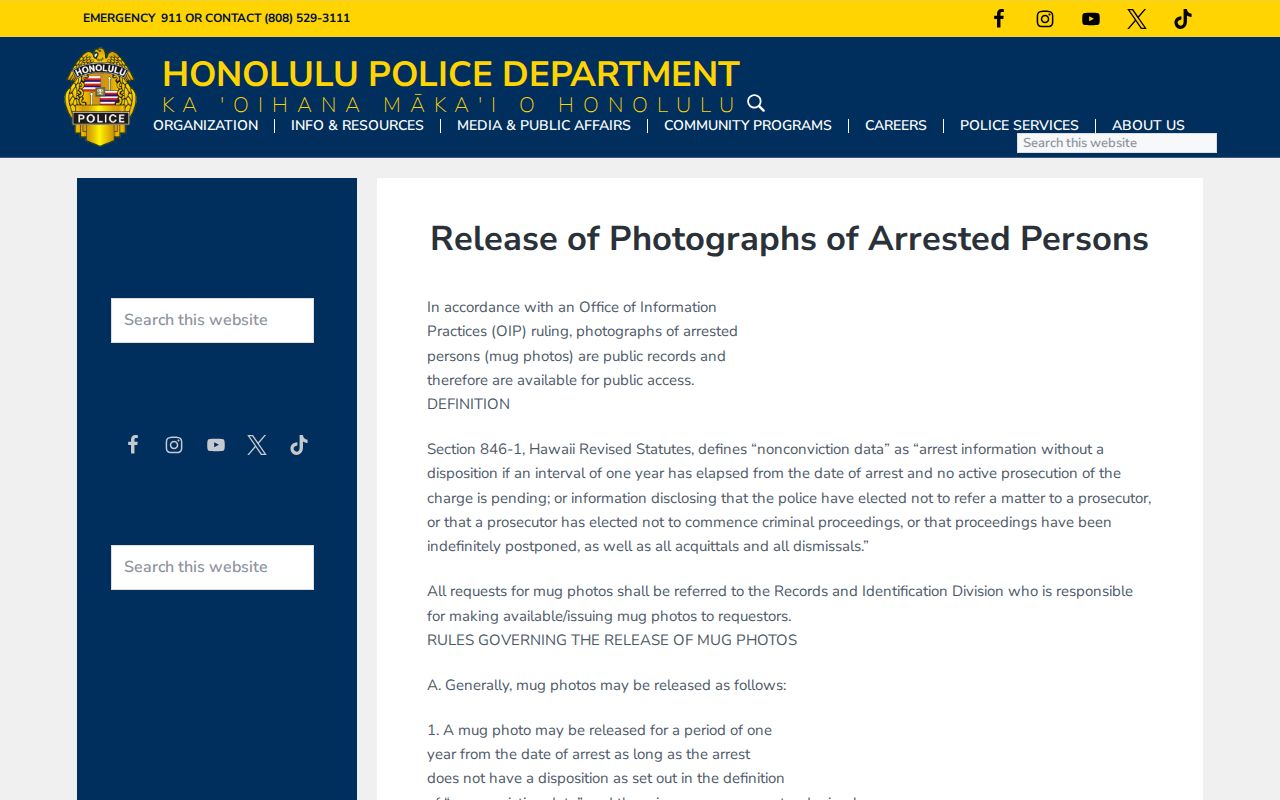
The policy, not an unofficial gallery, determines whether HPD releases the image.
Honolulu News Photo Limits
HPD, DCR, the Honolulu prosecutor, and established newsrooms may publish selected case images. Publication is not comprehensive. An old story may retain a photograph after dismissal, expungement, release, or a later change in the case.
Commercial aggregation pages can copy stale images, confuse people with similar names, or omit later outcomes. They should not be used to confirm release. Match any discovered image to the official report and current court record.
Honolulu Expungement and Photos
The Hawaiʻi Criminal Justice Data Center handles qualifying nonconviction arrest-information expungement under HRS §831-3.2. Its official expungement page estimates about 120 days and states that there is no expedited service. Court sealing follows a separate Judiciary process.
Expungement is not a general conviction eraser and does not instantly delete every DCR file, court item, news archive, or copied image. Contact each record holder with the order and request its applicable correction or removal process. For HPD, the photograph policy expressly considers nonconviction and expungement status.
The Honolulu released-inmate record path explains how to confirm the underlying release.
How HPD Reviews Photo Requests
HPD’s policy routes a request through the Records and Identification Division. Form 434 is the operational request form. The requester should identify the person, arrest date, and report number, then ask HPD to state any ground for withholding the image.
The one-year policy period is measured from arrest and is not a promise of automatic disclosure. A nonconviction disposition, expungement, active prosecution, conviction status, and case-specific OIP guidance may affect the decision. The live policy must be checked because procedures can change.
HPD arrest-log PDFs should not be described as a photo feed. They provide arrest and disposition information, but the official sources do not establish that each entry links to a mug photograph. Use the log to find the report details, then make the separate photograph request.
Request Honolulu DCR Photographs
A photograph created during OCCC, WCCC, or prison admission belongs to the DCR record chain. DCR ADM.05.02 treats a photograph as a personal-record element. The policy does not establish a public gallery, and the DCR policy index marks the separate release-documentation policy confidential.
Confidentiality of a full release packet does not automatically answer whether a booking image can be separated and disclosed. Ask for the photograph tied to a specific admission and request reasonably segregable access under HRS chapter 92F. DCR may apply privacy, safety, or other lawful exemptions.
Also ask whether the image remains maintained. State Archives publishes DCR retention schedules, but the research did not support one reliable retention number for every inmate photograph. No indefinite public availability should be promised.
Honolulu Registry Photo Limits
Hawaiʻi’s covered-offender registry can display photographs for people who are legally required to register. The official search supports name and geographic fields, and its FAQ says data are updated nightly. That makes it a current statutory registry, not a general archive of released-inmate mugshots.
The registry warns that positive identity cannot be established without fingerprint comparison and that a printout is current only as of its timestamp. A similar name or photograph should not be treated as a final identity match. Registry status also does not prove parole, probation, present custody, or a release date.
Use the official covered-offender search only when the person is lawfully within its scope. Do not use it as a workaround when HPD or DCR withholds an unrelated booking image.
Match Honolulu Photos Correctly
Link the photograph to its source event. Record the agency, report or booking number, arrest or admission date, and the date the image was obtained. Then compare the name and identifiers with the public court case or release record.
A single person can have more than one booking image. Hair, age, and other features can change, and a copied image may lose its caption. Never infer the most recent custody episode from the appearance of the photograph. The official report number is a stronger match key.
- Booking photograph
- An image created during an arrest or correctional admission.
- Expungement
- A statutory process affecting qualifying arrest information, not every copy everywhere.
- Sealing
- A court process restricting access to specified court records.
- Segregable record
- A releasable part separated from exempt content.
Correct Honolulu Photo Records
Start with the office that controls the image. Give HPD or DCR the report number, admission date, and exact error. For a mistaken identity, explain which identifier conflicts. For an expunged matter, provide the agency with the official order or certificate and ask for its current procedure.
Court sealing and HCJDC expungement are separate. Effective July 1, 2025, HCJDC transmits granted expungement orders to the Judiciary for court consideration under the applicable process, while older orders may require direct court action. The Judiciary sealing page supplies the court route.
An agency correction does not control a news archive or an independent copy. Contact each publisher with the official disposition and request its correction policy. Avoid services that demand payment while making unsupported promises about complete removal.
Photos Do Not Prove Release
A booking image shows that an agency photographed a person during an arrest or admission. It says nothing by itself about bail, dismissal, sentence completion, parole, probation, or transfer. The date in a caption may be the arrest date rather than release.
Confirm release with the court order and the HPD or DCR movement record. If a detainer appears, verify the receiving authority. Keep the photograph citation separate from the custody-status citation.
This distinction also prevents an old image from being paired with a new case involving someone with a similar name. Report numbers, booking dates, and identifiers are essential.
Cite Honolulu Booking Photos
When an agency releases an image, preserve the source page, agency name, report or booking number, event date, and access date. Keep the accompanying disposition separate. This makes later correction possible if the case changes.
Crop or alter no official image in a way that changes identity context. If the agency supplies a redacted record, retain the redaction and cite the government source.
A responsible photo record includes the later case result when available. Link the image only to the matching event, not to an unsupported claim about the person’s current location or legal status.
HPD’s public counter and photograph policy are distinct from DCR’s personal-record rules. Send the request to the agency that created the image. If both handled the person during the same case, identify each custody episode separately and do not assume that the two booking photographs or identifiers are interchangeable.
A DCR photograph request should name the exact admission facility because OCCC, WCCC, and a state prison can hold different images from separate custody episodes. Ask whether the requested photograph is maintained and whether a nonexempt copy can be separated from confidential release documentation. If the image is withheld, the written response should identify the applicable UIPA basis instead of implying that every DCR booking photograph is categorically public or private. A later release, parole action, or court disposition should be documented separately from the image record. That distinction preserves the booking context without assigning the photograph a meaning it cannot prove.
Public Record Search
Sponsored Results