
Where Federal and Immigration Releases Go
No evidence supports presenting a Honolulu County-operated ICE jail. Immigration custody is administered through ICE Enforcement and Removal Operations, federal facilities, and contract arrangements. USMS handles federal court custody and transport, while BOP holds designated federal prisoners. A person may leave one of these systems for the community, supervision, removal proceedings, another facility, another sovereign, or deportation.
The word “released” should always name its custodian. Release from DCR to ICE ends state custody but starts or continues immigration detention. Release from BOP can lead to ICE, USMS, or state custody. An ICE release ends ICE detention, but the locator does not prove the end of every court duty or supervision condition.
How to Trace a Honolulu Federal Release
First determine whether the person was in immigration detention, federal pretrial custody, sentenced BOP custody, or Hawaiʻi DCR custody with a federal hold. The case type, agency paperwork, facility name, register number, or A-number usually points to the right channel.
- Use ICE ODLS for current or recently released immigration detainees.
- Use the BOP Inmate Locator for designated federal prisoners and former BOP inmates.
- Read the District of Hawaiʻi docket for federal bond, detention, sentencing, and release orders.
- For USMS pretrial custody, rely on the docket and official district contacts because no public general USMS detainee locator exists.
- Request the maintained record from the agency when the public result does not explain the transfer or release.
Do not search HI SAVIN for ordinary ICE or BOP custody. Hawaiʻi SAVIN covers DCR jurisdiction. The Honolulu County release record guide helps identify whether the trail begins with DCR, HPD, or a federal agency.
ICE Locator Coverage and Search Fields
The ICE attorney resources page states that the Online Detainee Locator System covers people currently detained by ICE and people released from ICE custody within the last sixty days. That limited recent-release window is not a permanent immigration custody archive.
| ICE search route | Required details and limits |
|---|---|
| A-number search | Nine-digit A-number, padded with leading zeroes when needed, plus country of birth |
| Biographical search | Exact name, date of birth, and country of birth |
| No result | May reflect spelling, recent processing, security exclusion, age, or the sixty-day limit |
| Located result | Can identify current detention location and facility contact |
Records for people under eighteen are not displayed. A negative search is not release proof. Try the precise identity information, allow for recent processing, and use ICE’s Detention Reporting and Information Line at 1-888-351-4024. It operates Monday through Friday from 8 a.m. to 8 p.m. Eastern.
The ICE resource supplies the scope shown below.
FDC Honolulu and ICE Custody
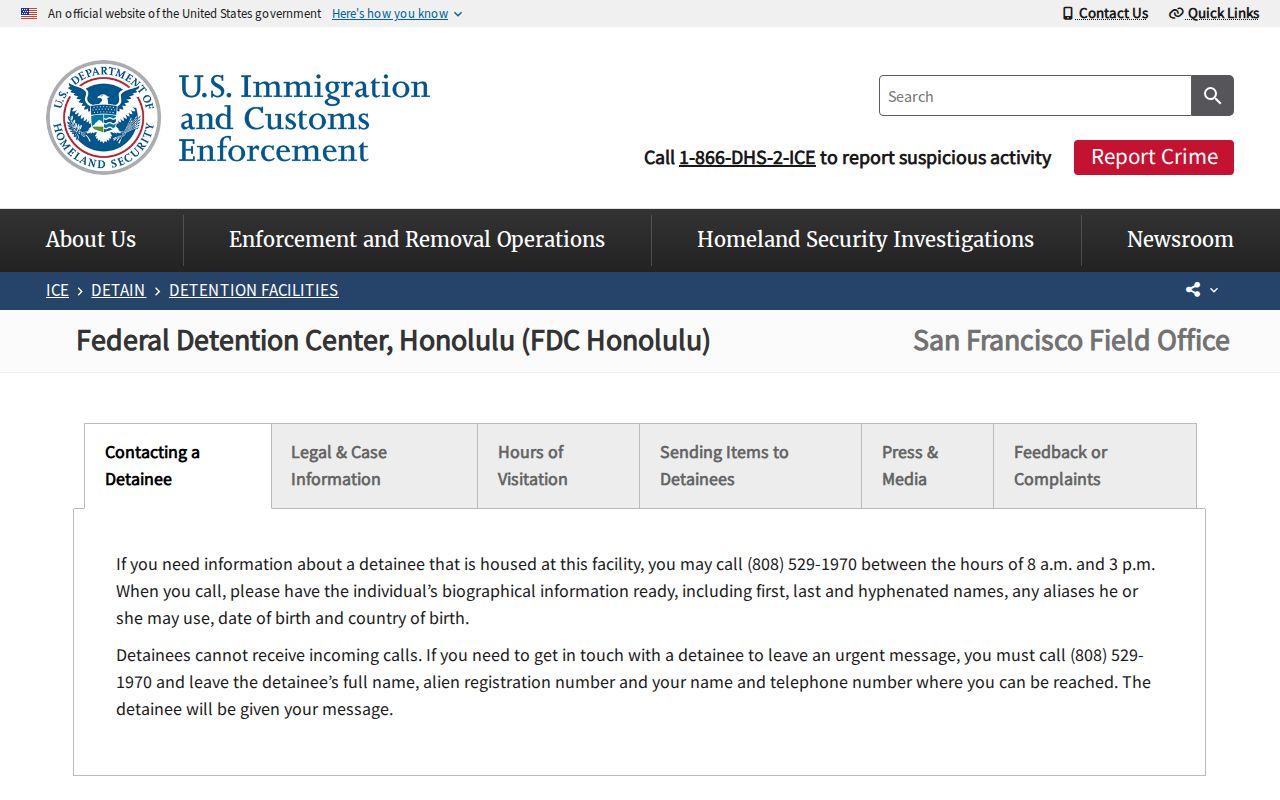
ICE lists Federal Detention Center Honolulu as a detention facility. This means criminal and immigration custody can intersect at 351 Elliott Street even though the legal authorities remain distinct. A person may leave BOP custody without leaving the building or federal control.
The ICE FDC Honolulu listing confirms that immigration detainees can be held at the facility.
Use the agency associated with the custody episode. BOP’s locator describes BOP status. ICE ODLS describes ICE detention. The federal docket can show criminal release terms, but it may not publicly reveal all immigration processing.
USMS Custody in the District of Hawaiʻi
The U.S. Marshals Service manages federal pretrial prisoners and movements for the District of Hawaiʻi. It has no public general detainee or recent-release locator. A person may not appear in a normal BOP result before sentencing and designation, even when held in a federal facility.
Use PACER or the District of Hawaiʻi clerk to read detention, bond, release, commitment, and sentencing orders. The docket establishes legal authority, while the physical custodian or USMS record establishes where and when the person moved. An order granting release can still be delayed by another hold.
USMS records follow federal FOIA and Privacy Act rules. Ask narrowly for the custody or movement field needed, and expect privacy restrictions for third-party requests. A public docket copy is often the most accessible source for the court’s action.
BOP Release Results Versus ICE Results
BOP’s Inmate Locator can display name, register number, age, race, sex, release date, and location. A past release date with no facility, or a location shown as “RELEASED,” means the person is no longer in BOP custody. It does not establish the absence of ICE detention or federal supervised release.
ICE uses a different identity system and time horizon. ODLS can show a current detainee or someone recently released from ICE custody, but its recent-release reach is sixty days. A person can therefore have a clear BOP history and no current ICE result for several legitimate reasons. Preserve the exact wording and date from each source rather than merging them into one status.
Detainers Block Community Release
Hawaiʻi DCR’s release policy provides the local bridge into federal custody. Staff must contact an agency that lodged a detainer and may not release the person unless the hold is rescinded or that agency takes custody. A DCR disposition that closes an OCCC or WCCC episode can therefore be the start of ICE or USMS custody.
Ask DCR for the destination or receiving authority and for the definition of any return or transfer code. Then use the receiving agency’s locator or docket. This prevents a common error: treating “released by DCR” as a statement that the person entered the community.
Federal and Immigration Record Requests
A focused request should identify the person, agency, facility, custody dates, number used by that agency, and the specific fields wanted. Useful fields include admission or assumption of custody, facility, transfer date, release date, release category, and receiving authority. Avoid asking one agency to certify another agency’s status.
BOP and ICE use federal FOIA and Privacy Act channels. The federal court supplies its own docket and certified copies. USMS records require a USMS request, and DCR records remain subject to Hawaiʻi UIPA. Privacy, safety, law-enforcement, and personal-identifier limits may restrict disclosure, especially for a third party.
If the issue is a current ICE location, start with ODLS and the information line. If it is the reason federal criminal custody changed, start with the docket. If it is the end of a sentenced BOP term, start with the BOP locator. Choosing the right custodian is more reliable than sending the same broad request everywhere.
Federal Supervision Is Not Custody
Release from physical federal custody may begin a term of supervised release. U.S. Probation oversees that court-ordered status, not BOP. A BOP released result therefore does not mean the federal sentence and all court obligations are complete.
Immigration release can also carry reporting or proceeding requirements that are separate from incarceration. The public locator should not be used to guess confidential case-management details. Read the public order and seek the appropriate agency record for the narrow status being confirmed.
Agency Records Complete the Custody Timeline
A reliable timeline uses the identifier, case number, exact dates, and exact agency wording rather than name alone. Compare the last event held by this custodian with the first event held by the next one. A court order may authorize release without recording the physical exit time, while a locator status may describe only one agency. A transfer, designation, detainer pickup, or processing delay can explain why dates do not align.
When public search results leave a gap, request the maintained movement fields from the agency that controlled that stage. Ask for assumption of custody, facility, transfer or release date and time, disposition, destination, and receiving authority. Court documents come from the court, BOP and ICE records use federal FOIA or Privacy Act channels, and HPD or DCR records use the applicable Hawaiʻi process. Third-party requests may face lawful privacy limits.
Preserve each result with its source and update time. Do not merge a BOP release, ICE result, HPD disposition, and DCR movement into one unqualified status. Matching the end of one custody episode to the beginning of the next distinguishes community release from continued confinement and gives the record holder a precise issue to confirm.
Public Record Search
Sponsored Results